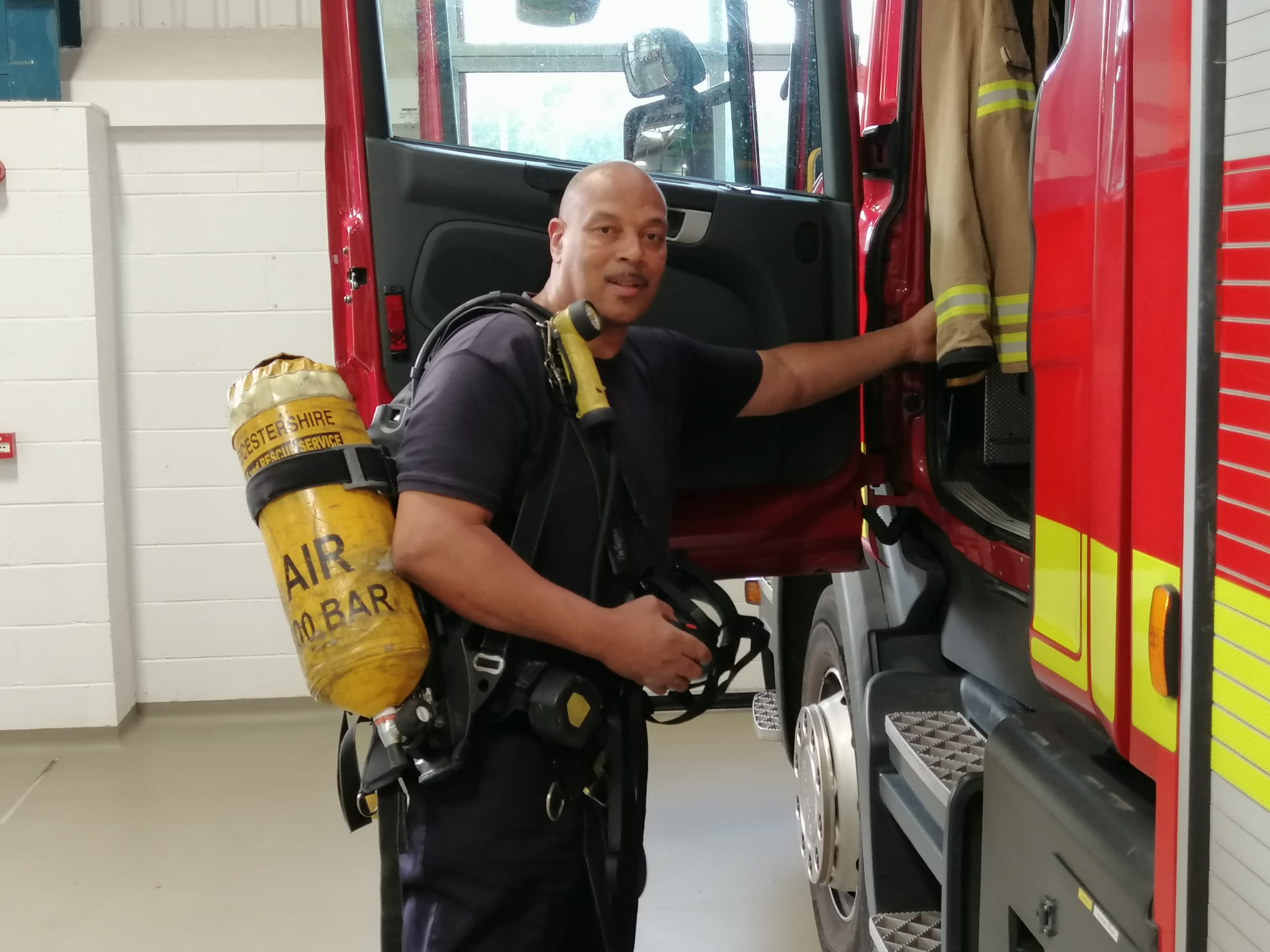
Ronnie Stanley retired from his job in April after 42 years fighting fires – and for more than 20 of them working to make the fire service more representative of the communities it serves
The first black firefighter in Derbyshire, Ronnie began his career in 1981 as inner-city riots broke out. Though there were vacancies on three station watches, the 19-year-old was assigned to white watch and soon found himself “baptised into racism”.
This involved not just demeaning “jokes” and “banter” – but apparently well-intentioned “compliments” which spoke volumes – “I don’t really like black people, but you’re alright”.
Ronnie, who won a coroner’s commendation for saving a four-year – old who sadly later died, loved the job. He fought back against racism at work, using “banter” – such as asking those who said they didn’t like black people just how many black people they had met.
By 1988, he was starting to feel he’d “had enough” of both Thatcher and the relentless micro-aggressions at work.
There was a “trigger moment” when the station’s tradition of giving the watch member with the longest service a chance to train as driver was ditched.
The vacant post went not to Ronnie, but to a firefighter who had just joined the watch. “No-one spoke up for me,” he says.
By 1988, he was starting to feel he’d “had enough” of both Thatcher and the relentless micro-aggressions at work.
Soon after, on a skiing trip to Canada in 1988, he met firefighters who encouraged him to relocate. Before long he was fighting fires in British Columbia – the start of 11 formative years and “a good grounding in trade unionism and equality”.
Much had changed when he returned to England in 1999. Labour was in power and newly launched FBU equalities sections were starting to champion the needs of firefighters from minority groups.
Ronnie, now a firefighter in Essex, soon dived in. Within a couple of months, he was black and ethnic minority members (B&EMM) brigade rep, regional rep in Essex, and helping to shape policies on the national committee.
Carl St Paul, a founder member of B&EMM, first met Ronnie at the section’s national school at Wortley Hall.
“It was clear firefighting ran through his blood,” says Carl. “His experience of observing racism in the service, and indeed dealing with it at first hand, was quite extensive – though at 6' 4" he had a particular way of making sure racist cowards avoided him.”
Amit Malde, B&EMM national secretary, says Ronnie inspired many firefighters, “embodying the B&EMM motto ‘lift as you climb’.”
Ronnie welcomes the union’s commitment to diversity and equality, but says black members are “well aware” that the union’s executive no longer has anyone on it who “looks like us” to convey black members’ take on policies.
He is quick to acknowledge advances in the workplace – with more white colleagues speaking out about the need for equality and inclusion.
Good employers are getting the message too, though “pockets of negativity” remain. “Much has been achieved – but there is still a way to go”.