
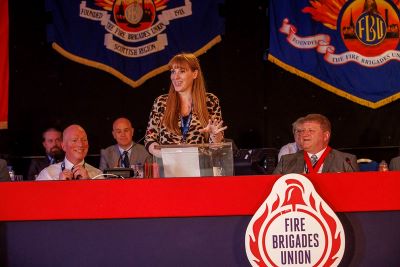
Elected representatives from every brigade across the union gathered in Blackpool’s Imperial Hotel in May to decide the direction of the union for the year to come.
This has been a momentous year. Since last year’s annual FBU conference, the cost of living has skyrocketed. We have had three prime ministers. Workers’ rights have faced vicious political attacks. And the trade union movement has launched its biggest fight back in decades. In the wake of the FBU’s fierce campaign for fair pay, with a historic strike ballot result forcing movement from employers, there was much to reflect upon and discuss at the FBU’s 94th annual conference in Blackpool this May.
Reps shared their experiences of bringing workers together
Elected representatives from every brigade across the union gathered in the Imperial Hotel to decide the direction of the union for the year to come. Delegates presented, debated, and voted on resolutions covering subjects ranging from improving pay, tackling discrimination, fighting for health and safety, to defending the right to strike.
After three days of packed agendas, with many first-time speakers welcomed alongside union stalwarts, energy in the conference hall ran high. More than 100 firefighters and control staff left Blackpool that week to return to workplaces across the UK, ready to organise and prepared to fight for the future of the fire service.
REFLECTIONS ON THE PAY CAMPAIGN
This spring, firefighters moved employers from an insulting 2% pay offer made last June to 7% backdated for 2022 plus 5% from this July, following a sustained campaign for fair pay.
An overwhelming 88% of FBU members voted yes to strike action on a 73% turnout (and higher in Northern Ireland): a strike ballot result that smashed through anti-union barriers. This piled the pressure on employers and led to the increased offer, which four out of five of the entire membership voted to accept.
Conference opened with a short film featuring general secretary Matt Wrack describing the timeline of the campaign, alongside interviews with FBU reps from across the UK. Reps shared their experiences of organising during the dispute: taking action for the first time, facilitating packed out meetings and bringing their watches and fellow workers together throughout the year.
The FBU will immediately begin preparations for next year’s pay claim, while pushing for progress on pay for control and retained firefighters
Following discussion of the key events, strategy and tactics of the pay dispute, conference resolved to continue the pay campaign: fighting to deliver professional pay and to restore ground lost during the years of austerity.
The FBU will immediately begin preparations for next year’s pay claim, while pushing for progress on pay for control and retained firefighters, and for continued professional development and pay progression.
However, the government is currently threatening to take away firefighters’ seat at the national negotiating table by removing the National Joint Council, which sees the union sit directly opposite employers. The FBU will therefore take action to defend UK-wide collective bargaining, and to oppose the imposition of a “pay review body” which has prevented other public service workers from negotiating acceptable pay offers.
The union will also launch a major campaign for long-term investment in UK fire and rescue services, to ensure the service is equipped to keep the public safe and to secure lasting improvements in pay.
THE FIGHT FOR EQUALITY IN THE FIRE SERVICE
After decades of failure by politicians and management, delegates voted for the FBU to take a leading role in fighting discrimination, harassment and bullying in the fire service.
This follows recent reports finding homophobia, sexism, racism and other forms of discrimination have gone unchallenged in UK fire and rescue services.
Putting the same leadership in charge of rescuing this situation would be entrusting it to the people who created the mess in the first place.”
FBU general secretary Matt Wrack introduced an executive council policy statement by highlighting how “the government and chief fire officers have systematically failed to address the issue of equalities over decades and especially since 2010, when central government dropped its drive for equality and handed all control to local chief officers and local politicians. Reports have shown how racism, homophobia and misogyny are routinely ignored, or even instigated, by people at the very top. Putting the same leadership in charge of rescuing this situation would be entrusting it to the people who created the mess in the first place.”
Members spoke about the need for standardised support for firefighters with physical or mental disabilities, sharing moving personal testimonies of times when support and training has made a significant difference.
To tackle issues of inequality, the FBU’s black and ethnic minority members (BEMM), LGBT+, and women’s sections will work with brigade committees across the union to create a set of fire service reforms. The union will hold fire services to these standards, and fight for changes to be implemented.
Firefighters will also play a key role in defending the values of fairness, dignity, and respect in their workplaces, stamping out discriminatory behaviour and language. Delegates wore t-shirts bearing the message “Equality Matters”, and members were given new poster packs to distribute.
DEFENDING THE RIGHT TO STRIKE
Resistance to the Conservatives’ Minimum Service Levels Bill was a recurring rallying cry at this year’s conference. This new legislation would see workers sacked for striking, and the FBU has called for a mass movement of non-compliance.
Ian Murray, FBU president, opened proceedings with a speech declaring that “we’ll fight with every weapon in our armoury to oppose this denial of our right to strike and we’ll carry on fighting until the laws are scrapped”.
TUC general secretary Paul Nowak addressed the hall, vowing that the TUC “will not stand by if any firefighter, any teacher, any rail worker or any civil servant loses their job”. He added that “we’ll fight to defend the right to strike and we’ll fight to defend every single worker who exercises that right.”
We’ll fight with every weapon to oppose denial of our right to strike
Labour’s deputy leader Angela Rayner also took to the podium, promising that Labour will repeal this legislation within the first 100 days of government. She announced that “the next Labour government will release the shackles of 13 years of Conservative rule, so that you once again have the freedoms and legal rights to properly stand up for your members.”
HEALTH AND SAFETY: DECON
In light of the latest reports on the risk of cancer for UK firefighters’ commissioned by the FBU, the DECON campaign was high on the agenda.
Riccardo la Torre, FBU national officer, has pioneered the campaign to protect and prevent exposure from toxic contaminants.
He updated conference on the latest research, carried out independently by the University of Central Lancashire, declaring that “firefighters are dying far too young and far too often and fire bosses are asleep at the wheel on an issue that is killing us. We are sick and tired of being told that we’re out of step with the rest of the world on this – there is absolutely no need to be,” he added to applause.
The DECON project is an astonishing piece of work that we should all be proud of
Ed Kelly, general president of the International Association of Fire Fighters (IAFF) brought a message of international solidarity from the US and Canada, describing the shared struggle for protections against occupational cancer.
Professor Anna Stec, an expert in fire toxicity at the University of Central Lancashire, explained how the progress made in the US and other countries has been resisted by the UK government.
She congratulated FBU members for fighting on, saying that “within the past six years, we achieved the same amount of work that took 20-30 years in the US and Canada. “The DECON project is an astonishing piece of work that we should all be proud of.”
PREPARING FOR THE NEXT GENERAL ELECTION
With a general election looming, conference turned its sights to making sure that the next Westminster government delivers for working people.
As a Labour affiliated union, the FBU has a seat at the table to argue for the party to back its policies. Conference called for the next Labour government to commit to scrapping all anti-trade union laws, fully funding the fire service, and delivering public services in public ownership.
HONOURING ACTS OF SOLIDARITY
Three FBU solidarity medals were awarded at conference, honouring solidarity of exceptional merit. These were presented to:
● Solicitor Ivan Walker, who has worked for years on the FBU’s legal challenge to unjust changes to pensions;
● Professor Anna Stec, who has led the scientific study of firefighters’ exposure to toxic contaminants; and
● Dave Badillo, a London firefighter who has undertaken inspiring work in the Grenfell community following the tower fire.
A UNIQUE FUNDRAISER
Delegates raised more than £1,700 for refugee charity Care4Calais through sales of a special FBU solidarity t-shirt featuring Paddington Bear.
National officer Tam McFarlane celebrated the success of the fundraiser as a display of firefighters’ proud humanitarian support, and an “expression of FBU solidarity with people fleeing war and oppression”.