
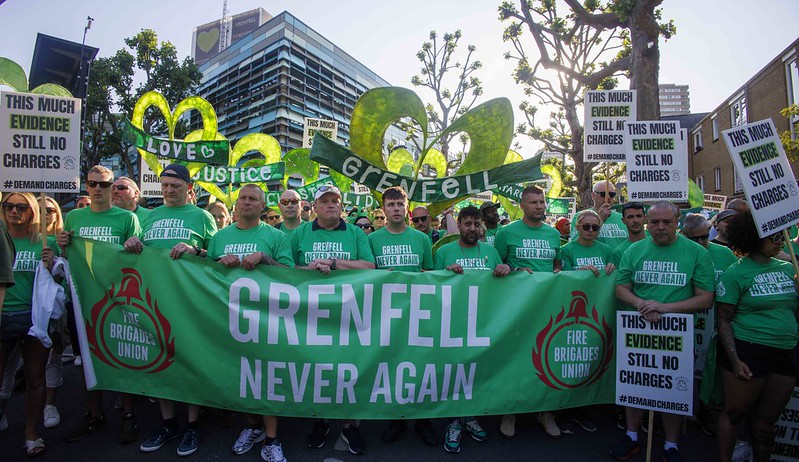
Francis Beckett meets Dave Badillo, who was on the first fire engine at Grenfell Tower six years ago, and who will not be silent about the disaster and the reasons for it
Six years on, Dave Badillo still finds the night of the Grenfell fire hard to talk about. He’s had enough practice. He was in the first fire engine on the scene, and he’s always in demand – more than he would like, really. “I feel everyone must be sick of seeing my face, as though there was no one else there,” he tells me. “After five years, I needed to take a bit of a break from it, for my own mental health.”
But he still speaks, because if he doesn’t, nothing will change. He feels he owes it to his profession, and to the community in North Kensington.
He talks about the fire and the lessons to be learned, and spares no one. He turned down his invitation to 10 Downing Street, telling Prime Minister Theresa May that he held her in contempt for the neglect she had shown to the Grenfell community and the fire service.
He runs a Twitter account. “Every Londoner should be aware” he tweeted on 2 July 2022, “that at times this week a quarter of London’s fire engines were unavailable due to understaffing. And things are not going to get better anytime soon”.
THEY CAN’T GET AWAY WITH IT
He says: “As long as we’re still talking about Grenfell, they can’t get away with it.” By “they” he means “the council, and the corporations which put that lethal material on the sides of the tower, the government whose slack regulations let these materials be sold in the UK – and the government is still dragging its feet. We still don’t have PEEPS (Personal Emergency Evacuation Plans) to get disabled residents out, and a lot of disabled residents died in Grenfell.”
At least all new high rise buildings must now have two staircases. A second staircase would have saved lives at Grenfell.
‘That night was like nothing we had ever done before. A lot of the training went out of the window, we just did all we could’
At first the London Fire Brigade tried to keep him quiet. “They were scared of any firefighter who had been at Grenfell talking to the press. They talked about community engagement but tried to discipline me for helping the community.”
After 23 years at North Kensington fire station, he’s a part of the community, and he persisted. “I always knew the union had my back,” he says, and today, “my relationship with the LFB has improved massively. They give me time off to organise the firefighters’ guard of honour for Grenfell’s silent walks.”
The fire service itself isn’t immune from criticism, he says. “The stay put policy was drummed into us in training school. In Grenfell it did harm but in some cases it saves lives. There has to be a serious plan B. There were a lot of equipment failures. We went into that tower with no water and the higher up we went no working radio – going against all policy.”
HIDING BEHIND THE FIRE SERVICE
But “the government and the companies tried to hide behind the fire service.”
Now 50, he speaks with the authority of a man who has been a firefighter for a quarter of a century. “It’s what I always wanted to do. My mum says I wanted it when I was five. I love the job still. You become very close to those at the station you work with, you build friendships and camaraderie with your watch. When the bells go down you get an adrenaline rush. I love that feeling. I get a real rush from helping someone – not necessarily something dramatic, maybe getting someone out of a lift.”
Did Grenfell change how he felt about the job? “I still love the work. Maybe it changes the way you work a bit, makes you more wary, more cautious. That night was like nothing we had ever done before. A lot of the training went out of the window, we just did all we could.”
It left him with post traumatic stress disorder, haunted by what he saw, what he did, and what he could not do. His wife Claire became more concerned for his safety, but “she comes down to the station, she knows the people I work with, she knows that if I get into trouble they’re not going to leave me there.” Claire is a cabin crew member for Virgin, so “we see each other like ships in the night” and they take turns caring for their children, aged six and three.
He carries with him a picture of 12-year-old Jessica Urbano Ramirez, whose sister asked him to search for Jessica. By the time he got to the 20th floor through thick smoke, Jessica had fled to the 23rd floor, where she telephoned the emergency services, and where she died. If Dave had been told where she was, he would have gone there. The next day, Dave discovered she was the niece of an old friend.
Telling that story to the public inquiry brought him to tears. He finds the delay in the final inquiry report, now due next year, frustrating. But, he says, “hopefully it means they are being extra careful to get everything right. There’s so much evidence for them to consider.”