FBU general secretary Matt Wrack looks back at the history of the FBU’s recent campaigns on firefighters’ pensions.
Thousands of FBU members will soon start to receive injury to feelings payments as part of the FBU’s 2019 legal victory over pensions.
These payments (£3,750 for the majority) are a high profile win because they are so tangible. But they are a tiny fraction of the story. For 20 years, the FBU has fought to defend your pension.
The right to retire on a liveable pension is one of the most important rights workers have. Without it, we are forced to rely on family or to face the final years of our lives in poverty.
The job of a firefighter is physically and mentally stressful. It requires a high degree of fitness. Occupational pensions in the fire and rescue service were introduced in 1948, with the government recognising them as “a generous scheme because of the nature of the job”.
In recent decades, firefighter pensions have come under attack by governments of all stripes. Most of these have been described as “modernisation”, but they are about making us work longer, pay more and get less when we retire.
PENSION AT 55
Until 2006, firefighters’ normal pensionable age was 55. Some firefighters were able to retire earlier under the “rule of 75”, which enabled firefighters over the age of 50 to access at least some of their pension if their age and their years of service added up to 75.
But in 2005, the New Labour government proposed to raise the normal retirement age to 60. The new scheme would also introduce much more stringent criteria for achieving an ill-health pension.
The FBU opposed these changes and took steps towards a nationwide strike in early 2006. This formed part of a wave of industrial action ballots on pensions, with 1.5 million public sector workers moving towards industrial action.
After negotiations, ministers agreed to “ringfence” pensions, meaning that those already in the scheme would not have their retirement age altered. The government also backed plans to give retained firefighters access to a pension, and backed away from excluding certain additional allowances from pensionable pay. For the first time, cohabiting partners would not need to be married to a firefighter to access their pension in the event of their death.
The FBU called two special conferences to debate our next move. After consultation with members, the second special conference in March 2006 voted not to continue with a strike ballot, although this did not mean any agreement with the changes.
The government made substantial concessions because of the threat of strike action, but the FBU continued to oppose the changes. We were left with a two-tier pension system, with those joining the service after 1 April 2006 in the New Firefighter Pension Scheme (known as the 2006 scheme or NFPS), and those already in post retaining the old scheme (known as the 1992 scheme).
The estimated total benefit so far to members of the FBU, and to members of other public sector trade unions, of the union’s success in fighting for pensions justice is £19 billion
The Conservatives returned to power in coalition with the Liberal Democrats in 2010. Their time in office has been a disaster for the fire and rescue service, with one in every five firefighter jobs lost and 30% of central government funding to the fire and rescue service cut.
Austerity was a ruthless attempt to make workers pay for the banking crisis, and our pensions became a target. Following a review led by Lord Hutton, the coalition government moved forward with a massive attack on all public sector pensions: increasing employee contributions, shifting to the less generous consumer price index (CPI) measure of inflation, moving from final salary to career average, and making firefighters work until 60 regardless of when they joined the service.
2011 witnessed some of the biggest strikes in recent UK history. The largest was on 30 November, when a total of 29 unions took action. Two million people struck, making it one of the biggest single days of strike action since the general strike of 1926.
DIFFERENT TIMETABLE
The FBU vocally supported other unions, but our strikes took place on a different timetable. We hired actuaries (specialist pensions analysts) to challenge the government’s assumptions about the cost of our pensions, which meant that the parameters of our dispute had not yet been set in 2011. As a result of this, the government agreed to halve increases to employee contributions for firefighters.
But our turn would soon come. In September 2012, the government included the fire and rescue service in its Public Service Pensions Bill. Under this legislation, the retirement age would move to 60 and employee contributions would rise (to 10.4% for those on the 2006 scheme, and 14.4% for those on the 1992 scheme).
Throughout the dispute, we raised concerns that many firefighters would no longer be capable of doing the job in their late 50s. Without sufficient internal redeployment opportunities, the FBU feared employers would use capability assessments to dismiss them; the risk of “No job, no pension”. Many of our concerns were backed up by the independent Williams Report, which was commissioned by the government following pressure from the FBU and published in January 2013. The raising of the pensions age would particularly hit women firefighters, who have to contend with the effects of the menopause on their health.
The FBU began preparing internally for strike action as soon as it became clear that an attack on pensions was coming. The Public Sector Pensions Act became law in spring 2013, and we moved to ballot members in England, Wales and Scotland over the summer. They voted 4-1 to strike, an overwhelming mandate for action.
DEVOLUTION
Devolution made the dispute more complex.
In Northern Ireland, strikes were averted when the Stormont government agreed to keep the pension age at 55, following a major campaigning effort by the FBU.
The Scottish government came forward with proposals that would allow firefighters to retire at 55 with a much lower reduction in their pension, and issued a guarantee that they would not be sacked for failing fitness tests. This caused considerable debate among FBU members in Scotland, with 55% voting to suspend industrial action.
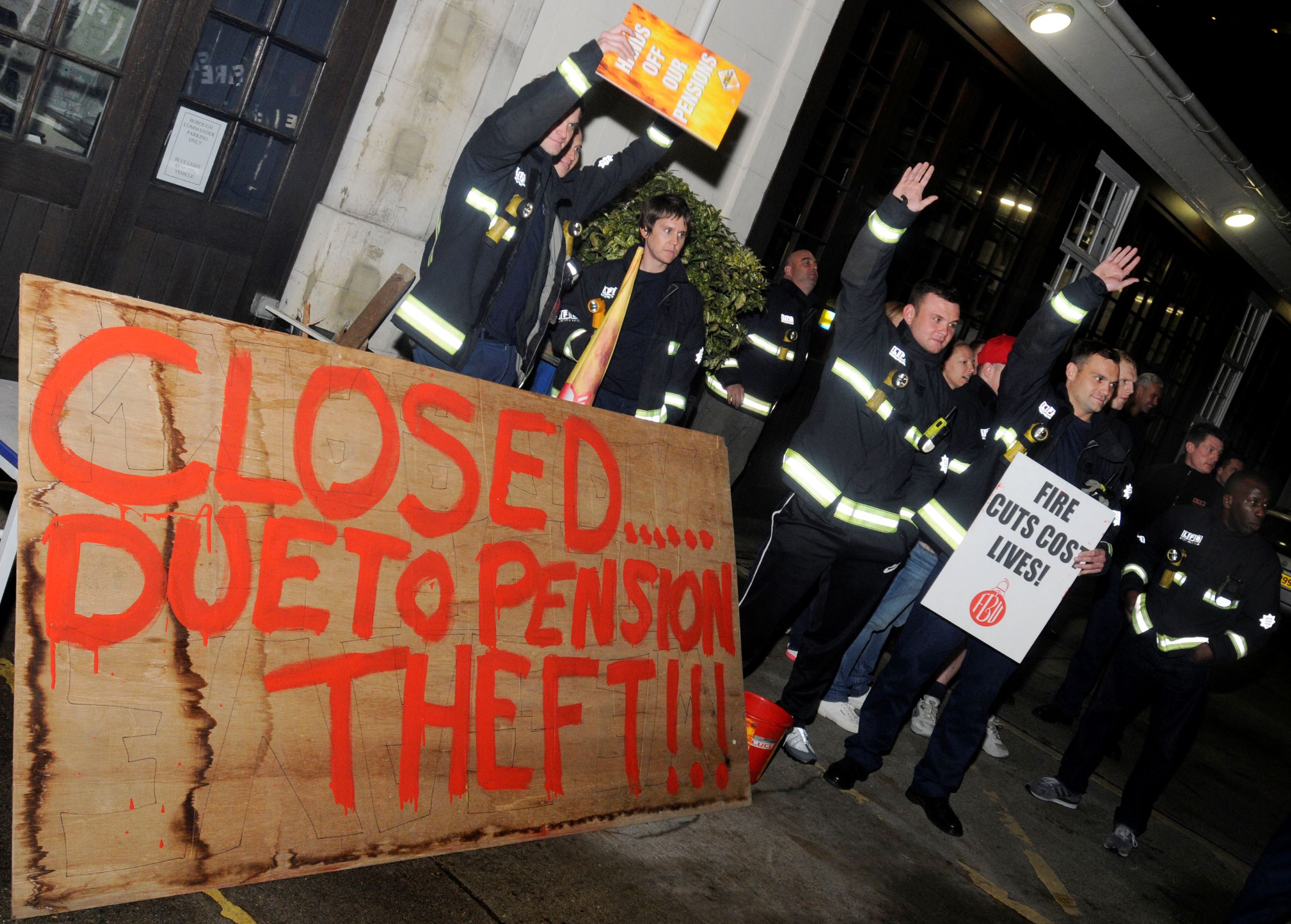
Between 2013 and 2015, the FBU undertook the longest period of strike action in our history.
Welsh firefighters joined for most but not all of this action, as the Welsh government consulted on its own proposals to soften the reductions to pensions for firefighters who retired at 55.
We hired specialist pensions analysts to challenge the government’s assumptions about the cost of our pensions
The longest of the strikes lasted four days, from 31 October to 4 November 2014. But many of the stoppages happened in short bursts of two hours. This was to maximise impact on fire employers, who had to pay for agency strikebreakers to provide cover, while minimising the impact on strikers’ pay.
We also organised a demonstration in London on 16 October 2013.
Firefighters travelled to lobby MPs at Westminster repeatedly.
Industrial and political pressure delivered results. On 15 December 2014, the Labour Party pushed for a vote on firefighters’ pensions, with shadow minister Hilary Benn taking apart the government’s case. The vote was lost, but the then fire minster Penny Mordaunt promised parliament that firefighters unable to maintain operational fitness over the age of 55 would either be redeployed or offered an unreduced pension.
FIREFIGHTERS FURIOUS
Firefighters were furious at being ignored and belittled by Tory ministers, and rightly so. On 25 February 2015, during a 24-hour strike, thousands of firefighters picketed parliament itself. Some wore Penny Mordaunt masks with a Pinocchio nose.
The new scheme was imposed by Westminster on 1 April 2015. As a result of our action, we achieved a major improvement in the actuarial reduction suffered by firefighters if they retire at 55: from 47.1% to 21.8% in England and 9% in Wales and Scotland.
We also made progress for firefighters incapable of working beyond 55. In Northern Ireland, firefighters still retire at 55.
Current firefighters pension scheme 2025 active early retirement factors are 20% at age 55, 16.6% at 56, 12.9% at 57, 8.9% at 58 and 4.6% at 59.
The FBU continues to make the case that a retirement age of 60 is not fit for purpose and that it potentially discriminates against women. This an ongoing fight for the union which is continually raised with the appropriate bodies.
RETAINED FIREFIGHTERS
Retained firefighters are some of the biggest beneficiaries of our campaigning on pensions.
As a result of pressure from the FBU, the Westminster government accepted that retained firefighters should have access to a workplace pension in 2006.
At the same time, an FBU legal challenge was successful in using the Part Time Workers Regulations (an EU directive) to argue that they should have full access to fire service pension schemes. This was a huge victory for retained firefighters and had implications for part time workers across the economy.
The FBU fight for retained firefighters’ pensions continues with the second options exercise and the retained pension aggregation fight.
Control staff have always been in the Local Government Pension Scheme (LGPS) which is less generous. The FBU rejected changes to the LGPS in 2012, but other unions (which have more of a say in local government schemes) voted to accept them. The FBU has always argued for control staff to be included in fire service pension schemes. It is wrong that control staff are separated from their station-based colleagues, and it makes little sense for a workforce to have their pay and pensions split over different systems of negotiation. The FBU continues to fight for the right of control members to be included in a fire service pension scheme.
The FBU has used every tool at its disposal to fight for firefighters’ pensions. Every year, we take hundreds of individual cases through the internal dispute resolution process, to the Pensions Ombudsman and through individual and collective legal challenges.
LEGAL ACTION
Legal action has won retained firefighters access to pensions and has given firefighters with permanent disabilities who retired through ill-health protection from having their ill-health pensions removed. We have used the courts to insist that additional allowances and day crewing payments are pensionable.
In 2018, the FBU challenged the way the government had implemented the 2015 pension scheme changes.
By standing together, striking together, and using the courts, we have preserved a lot and made some important advances
Because of pressure from the FBU and our allies, ministers decided to taper the introduction of the scheme over seven years in a way that amounted to discrimination based on age. We took them to court arguing this and after long legal battles, we won, meaning that firefighters got a full seven years back in the old scheme. This was a win not just for our own members, but for workers across the public sector. It is estimated that the total cost of our success is £19 billion. Millions of workers have benefited from this.
HIGH COURT
Outrageously, the government responded by making pension scheme members in the 2015 scheme foot the bill for this win. We have challenged this and expect a decision from the High Court in the coming weeks.
FBU members should rightly be proud of our achievements in defending pensions in the fire and rescue service.
The past two decades have seen attack after attack on workers and their pay and conditions. Our pensions have not been immune. But by standing together, striking together, and using the courts, we have preserved a lot and made some important advances.
Our battle on pensions is unfinished business: the fight continues.