Employers have a duty to ensure that workplaces are accessible to all, says FBU assistant general secretary Ben Selby
People with minds and bodies of all kinds and functions work in fire stations and control rooms. The fire and rescue service is neurodiverse, as is our union.
But employers are failing to consider this diversity, creating significant barriers at work. This has to change.
DISABILITY AND NEURODIVERSITY
Neurodiversity is an umbrella term referring to the many ways that people think and experience the world. It includes a range of neurological conditions, such as autism, attention deficit hyperactivity disorder (ADHD), dyslexia, and Tourette’s syndrome. Approximately one in seven people in the UK are in some way neurodivergent.
People who identify as disabled may have visual, auditory, physical or psychiatric impairments. Not all disabilities are visible to others: it is estimated that 70-80% of disabilities are invisible.
It is a myth that only one type of person can work in the fire and rescue service. Hundreds, possibly thousands, of FBU members are in some way neurodivergent or disabled.
Having a diverse workforce means that people bring different skills and experiences to their roles. Employers have a duty to ensure that workplaces are accessible, so that everyone can work safely and without undue stress or risk.
A firefighter with dyslexia may excel at navigating buildings due to their spatial awareness, while they may find it stressful to read small print. A person with autism may be highly skilled at absorbing details during fire control calls, while they might be hypersensitive to bright lights in the control room.
UNDERSTANDING DISABILITY
There are two main ways of viewing disability: the medical and the social model.
The medical model demands that employees “fit in or get out”. Impairments are seen as problems that must be fixed or treated to overcome difficulties. All the emphasis is on the worker, who is forced to attempt to change or to hide any struggle.
A firefighter with dyslexia may excel at navigating buildings due to their spatial awareness, while they may find it stressful to read small print
The social model says that people with impairments are not inherently disabled but are instead made disabled by barriers that commonly exist in society. The difficulties people may face at work are created by the failure of their employers to create accessible and inclusive workplaces.
Shifting to the social model enables workers to organise collectively. For the examples given earlier, legible, larger fonts should be used, and unnecessarily bright lights should be dimmed. Instead of individual workers being told that something is “wrong” with them, we can come together to demand that the conditions of work change.
WINNING FOR MEMBERS
Delegates at last years’ FBU conference spoke passionately about the need for support for neurodivergent and disabled firefighters. The FBU has promoted dyslexia awareness in the fire and rescue service for many years. But awareness alone is not enough, and now members are getting organised to take action more broadly.
The union is embarking on a process of learning which started this year with the publication of the FBU’s new Neurodiversity in the Workplace guidance. Written in collaboration with neurodivergent members and officials, this document aims to equip members, reps and officials with the skills and knowledge to fight for inclusive workplaces.
HISTORIC EVENT
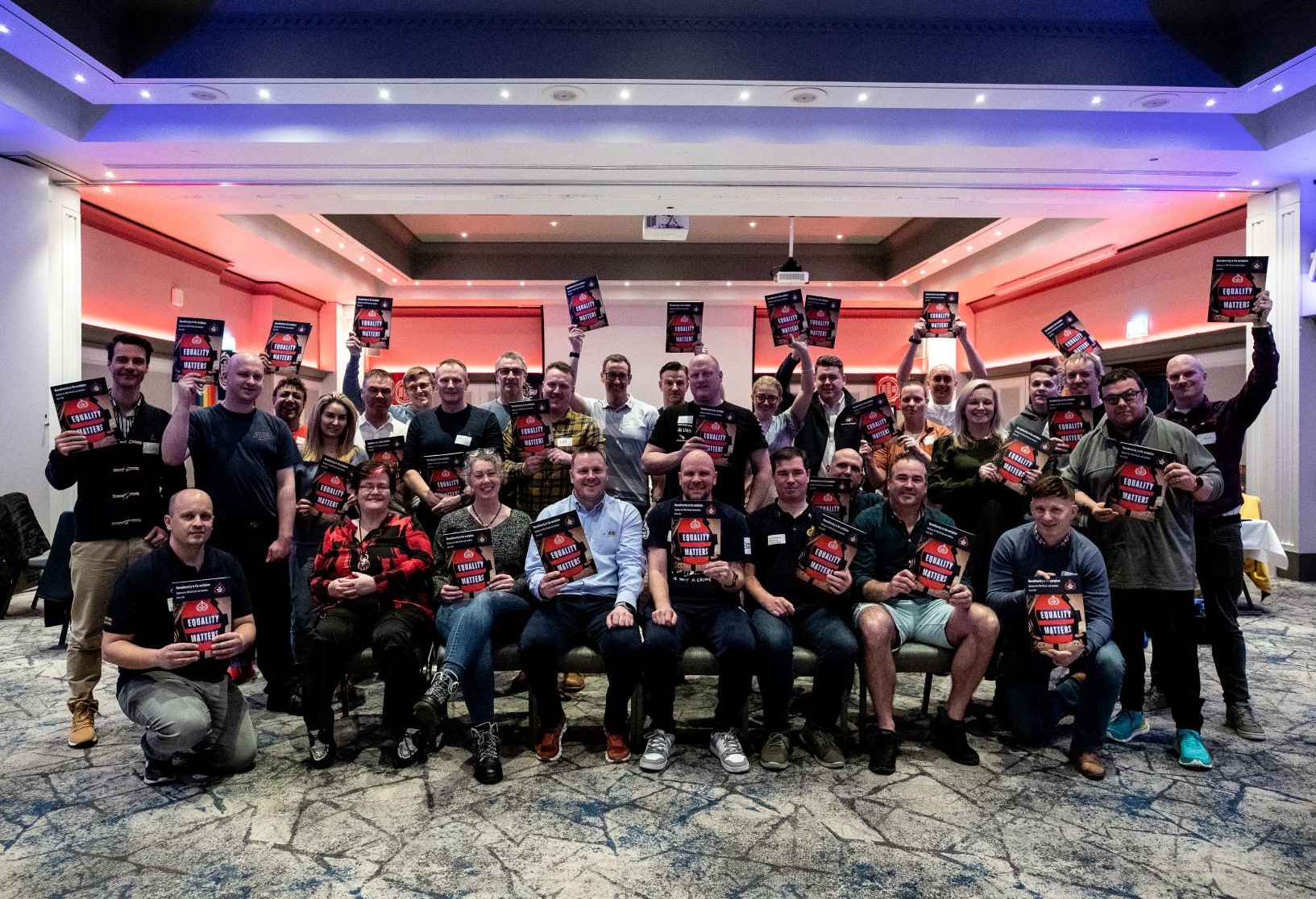
This March, members from across the union came together in Leeds for the FBU’s first disabled and neurodivergent forum. More than 30 FBU members attended from across the UK, to share experiences and begin UK-wide organising.
As with any trade union organising, we started by identifying the key issues in the workplace. Recurring themes emerged from discussions: discrimination and harassment; a lack of training and education on neurodivergence and disability; obstructive bureaucracy; and inadequate support. These challenges have been created by policies and practices that have been designed without the input of disabled and neurodivergent workers.
But members have started to build grass root networks locally, connecting firefighters and control staff facing these barriers at work. These groups are growing in regions from North Wales to London, providing support and starting to make progress.
Connections are also being made with the wider trade union movement. A panel of trade union representatives fed in about how disabled and neurodivergent members are organising for change in the RMT, NUJ, Unite, TUC and other unions.
THE FIGHT AHEAD
Equality is a core trade union principle, and we have much to learn from the workers fighting for accessible workplaces across sectors and industries.
This forum marked the beginning of disabled and neurodivergent FBU members formulating collective demands and organising to win improvements across the UK.
No-one should have to struggle alone. United, we can tear down barriers and create an equal and inclusive fire and rescue service.