As we prepare for the 1 November national rally, FBU general secretary Matt Wrack introduces the Firefighters’ Manifesto, which sets out our demands for our service, our profession and our conditions
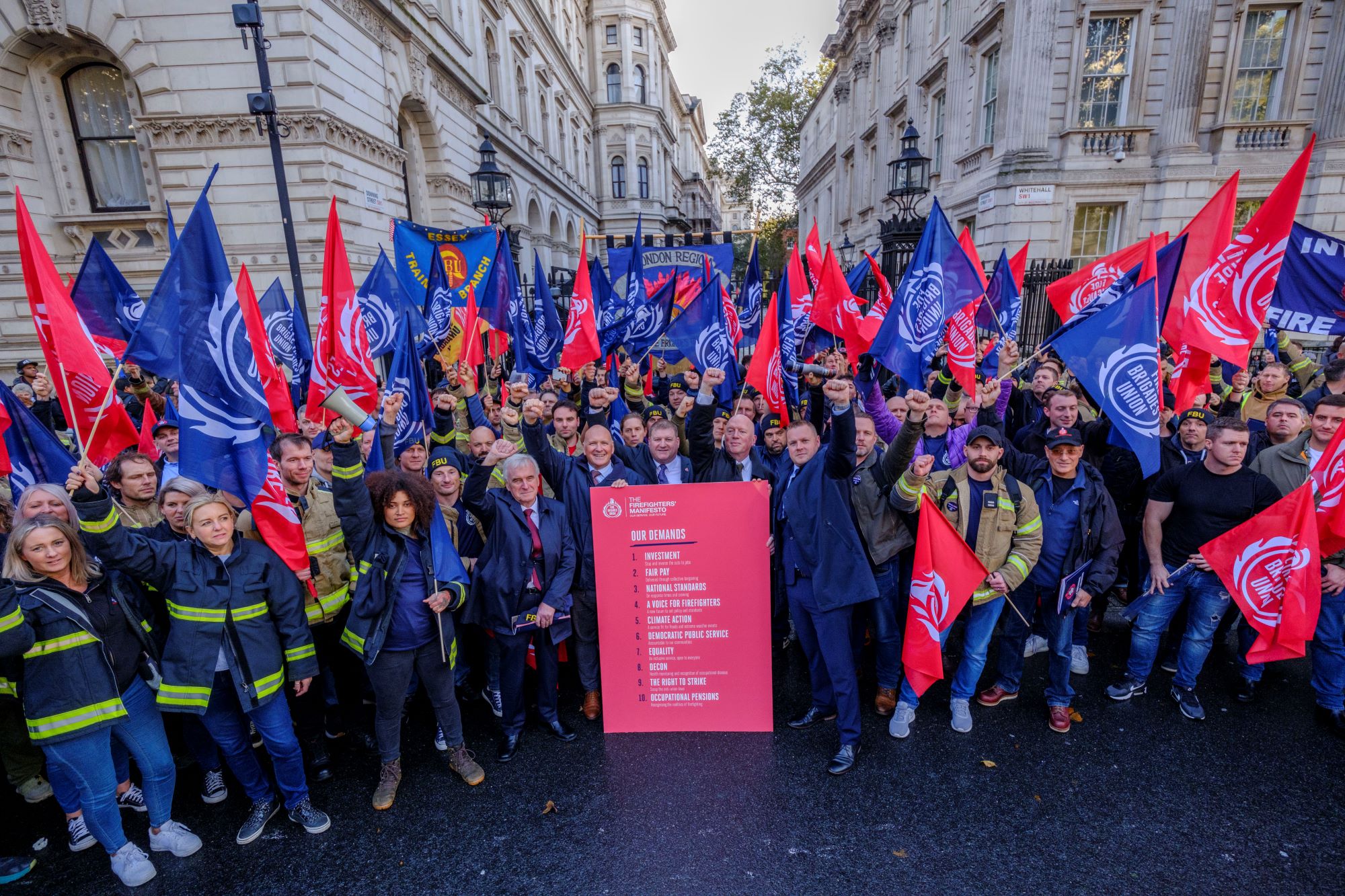
On 1 November, FBU members from across the UK will rally and march in Westminster to launch the Firefighters’ Manifesto – and that will just be the beginning of the campaign. Last year’s pay campaign showed that, when we stand together, we can shift our employers and the government. But now we need to do something much bigger – win a future for the fire and rescue service.
We are in a unique moment. It is likely that we will soon have a change of government, and this gives us an enormous opportunity to fight for jobs, investment and a fire and rescue service that is fit for the future.
The Firefighters’ Manifesto sets out our demands:
1. Investment: stop and reverse the cuts to jobs
2. Fair pay: delivered through collective bargaining
3. National standards: on response times and crewing
4. A voice for firefighters: a new forum to set policy and standards
5. Climate action: a service fit for floods and extreme weather events
6. Democratic public service: accountable to our communities
7. Equality: an inclusive, open to everyone
8. DECON: health monitoring and recognition of occupational disease
9. The right to strike: scrap the anti-union laws
10. Occupational pensions: recognising the realities of firefighting.
POLITICIANS NEED TO HEAR FROM YOU
In the coming months, firefighters and emergency control staff will be on the hunt for politicians. We are seeking to engage with current and future representatives at Westminster, as well as the devolved governments and assemblies.
We want an audience with councillors, mayors and other local bodies – and of course, with the wider public. Firefighters have a message for politicians high and low, new and wizened: invest in our fire and rescue service, listen to the professionals, and help us make the UK resilient to any emergency that comes our way.
But the message alone is not enough. Politicians need to hear from firefighters. They need to hear the voices of FBU members, who know the job and carry the service through every shift. They need to hear directly from firefighters.
INVESTMENT
Almost everything depends on money. Fire and rescue is a £3 billion a year industry. That’s a tiny percentage of government spending on public services – less than 1% annually. Across the UK, it costs around £50 per person per year to pay for fire and rescue. This is repaid several times over with lives saved, homes reclaimed, people rescued and businesses salvaged.
Politicians have starved us of resources. We’ve been a £3 billion a year industry for more than a decade. Spending has remained static while the cost of living has gone through the roof. Every year of inflation has eroded the funds available. Cuts have reduced the workforce by a fifth (20%). This dictates everything else.
Three-quarters of fire budgets are spent on firefighters, so cuts to funding inevitably impact on the number of firefighters employed.
WHY FIREFIGHTERS SHOULD MOBILISE
It is no surprise that, at the same time as cutting jobs, central government also attacked firefighters’ pay. They cut budgets and cut our pay for 13 years. Investment in our service must also mean more money for firefighters’ pay.
These cuts mean chief fire officers making preposterous and unsafe proposals to save money. Every firefighter knows you cannot put out a house fire safely without a minimum number of BA wearers and back up. Yet they increasingly tell us to ride three on a pump. They increasingly tell us to jump crew other appliances; all the time putting our safety at risk.
These cuts mean chief fire officers come forward to propose shift systems that reduce night cover. All the official figures show that during the night, fires and fire deaths are greater. The risks are greater when people are asleep. These are the ABCs of fire safety.
These cuts mean that, over the past two decades, response times to fires have slowed from an average of six minutes to nine minutes for primary fires. And this is just the first pump. They do not even publish figures for other appliances.
These cuts mean that, at major incidents, the service soon runs out of firefighters. We have seen in the wildfires last year, at recycling plant fires, floods and other major incidents, almost the entire shift is mobilised, leaving virtually no resources left for any other incidents.
On 1 November, firefighters are marching on Westminster to tell politicians what their cuts mean to our service. We are going to central government to demand the investment in our service that the risks warrant. The public deserves nothing less. And firefighters deserve much better.
ADVISORY BODY
Something else needs fixing too. For two decades, chief fire officers have had the ear of ministers. There is no seat at the table for the FBU. There is not even a table. Instead, a gang of chief fire officers tell each other they know best and tell ministers what they want to hear.
What does this arrangement mean for firefighters? For the past two decades, the National Fire Chiefs Council (NFCC) and its predecessor, the Chief Fire Officers Association (CFOA), have been asleep at the wheel in every major crisis facing the fire and rescue service.
They failed to warn about the building safety crisis and about the cladding that ruined so many lives at Grenfell Tower. Instead they proposed the “not-sotemporary” waking watches, where residents now have to pay untrained contractors while they rest their heads at night in homes deemed unsafe.
These policies mean some chief fire officers now want to send firefighters into high-rise residential buildings, when fires are blazing up there, without first starting up their BA. They think it is OK to break decades of safety procedures and put firefighters at risk of respiratory diseases or being overcome by smoke, instead of having enough firefighters to evacuate the block safely.
The same chief fire officers have presided over a culture of harassment, discrimination and bullying, setting back the drive for equality and diversity. Warm words and paper policies have masked unacceptable behaviours – long warned of by FBU reps and now exposed by official reports. Firefighters and emergency control staff want dignity at work. Nothing less will do.
The vast majority of firefighters belong to the FBU. To shut out the union is to deny firefighters our professional opinion
Chief fire officers failed to prepare for the Covid-19 pandemic. They provided no plans, no guidance and no training. When the FBU negotiated an agreement to help the public through the first year of the pandemic, some chief officers tore up safety agreements and put firefighters at risk.
For too long, ministers have relied solely on the NFCC. They have given chief officers millions of pounds of public money. But the chiefs have failed in their duty of candour. In the process they have increasingly excluded the FBU from almost every committee, every piece of guidance and almost every forum.
Firefighters are going to Westminster to tell politicians to listen. We are the professionals. Nobody knows the job better than those on the frontline. The vast majority of firefighters belong to the FBU. To shut out the union is to deny firefighters our professional opinion.
And the remedy is simple. Stop wasting public money on the NFCC. Set up a statutory advisory body with the FBU on board at every level. We can then crack on with improving the service to the public and creating a world class fire and rescue service.
RESILIENCE
Firefighters tackle every kind of emergency, 24 hours a day, 365 days a year. Firefighters receive the first call people make when it matters most and are the first line of defence when things go wrong.
The UK fire and rescue service can mobilise 10,000 firefighters in a matter of minutes to tackle almost every emergency imaginable. Specially-trained firefighters are on duty at all times, ready for deployment to incidents, large and small. The arrival of professional firefighters swiftly and with appropriate numbers is of tremendous value, both to those immediate victims who need our help and politicians who are accountable when things go wrong.
For too long, politicians have ignored public safety. Firefighters are proud of the jobs we do and the communities we serve. We want to make our profession the best it can be. The risks are still there from fires and other incidents. We know there are significant new risks now and on the horizon. Whether it is climate change or the ageing population or the housing crisis, we know there are vulnerable people out there who need our help.
Firefighters want politicians to give us the tools to meet these challenges. There is a golden opportunity to change direction and make the fire and rescue service resilient in the face of today’s emergencies. Firefighters have a vision of a better fire and rescue service. We have a union that articulates those views and stands together to improve our pay, pensions and conditions.
FBU members are heading for Westminster and other parliaments. We are heading for fire authorities and boards. We are talking about the job we love and the service we want to build. We need every member on board. Together, collectively, we aim to change things for the better.