
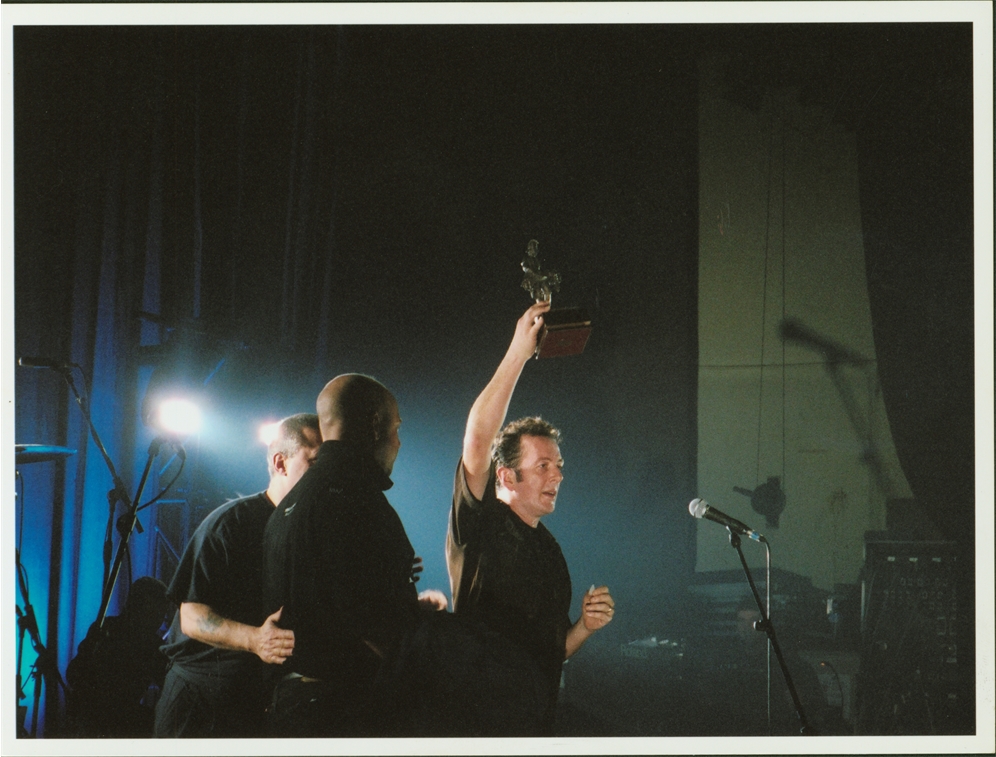
Gregor Gall, author of a new book on the politics and influence of Joe Strummer of the Clash, recalls his support for the FBU and other causes
Photo: With thanks to George Binette
The twentieth anniversary of two significant moments for many FBU members falls this autumn. The first is the benefit gig played for striking firefighters by Joe Strummer at Acton Town Hall in London on 15 November 2002. It was his last ever gig in London, his home town for many years. The second was his death just weeks later on 22 December, only a few months past his 50th birthday. There was a palpable sense that “only the good die young”.
Strummer was – and still is – an inspiration and source of sustenance to many activists in the FBU as I found out when carrying out the research for my book on his politics and their influence on people.
He was often said to have changed people’s lives as a result of not only fronting The Clash but also by writing most of the lyrics for the band, especially the more political songs like White Riot, Working for the Clampdown, Spanish Bombs, Washington Bullets and Know Your Rights.
INSPIRED
Among those inspired and influenced by Strummer are the union’s current general secretary, Matt Wrack, and the union’s previous general secretary, Andy Gilchrist.
Others include former FBU national officer, John McGhee, and former FBU branch activist, Mark Bedford.
So, why did Strummer agree to play the benefit gig and what does this tell us about his politics and their influence on people, especially within the FBU?
Strummer was for the whole of his life on the left and for the left, even though he became somewhat disillusioned by ‘new’ Labour’s subservience to the Thatcherite agenda of free market reform.
When he was contacted while touring in Japan and asked if he would play a benefit gig for the FBU, not only was he willing to do so, but he re-arranged existing dates to make sure it could happen
He had a long history of playing benefit gigs for progressive causes. His first gigs with his first band, the 101ers, were for political exiles from the Pinochet military coup against the democratically elected left-wing government in Chile.
With The Clash and then the Latino Rockabilly War and the Mescaleros, he played gigs for refugees, sacked miners, community causes and disenfranchised youth as well as against racism and fascism.
As Strummer said at the Acton Town Hall gig, public service workers like teachers, nurses and firefighters deserve to be paid decent wages and have decent working conditions because of the important work they do. Those are words that will resonate with people 20 years on as public service unions ballot their members for strike action to gain pay rises that match the rate of inflation in the current cost of living crisis.
As youngsters, the likes of Matt Wrack and Andy Gilchrist saw Strummer in The Clash when the band played live. His passionate performances meant that people took seriously what he was saying.
So, Strummer then played the role of an educator, opening their eyes to issues and events that were not covered at school. In an age before the internet, many went to local libraries to find out more about the Spanish Civil War or the Sandinistas in Nicaragua.
GET ACTIVE
But, more than that, Strummer encouraged people to do something about these causes if they agreed with him and felt strongly enough. He was never prescriptive. Individuals could choose how and what they got active in, whether it was a union, political party, social movement or community campaign. In addition to Wrack and Gilchrist, the general secretaries of the ASLEF, NUM and RMT unions have been followers of Strummer.
Strummer realised that music was a terrain which the left could use to fight right-wing ideas. This was because music is a mass cultural pastime, making it too important to be left to just lyrics about love and loss.
Instead, in his lyrics for White Riot, he sang “All the power’s in the hands of people rich enough to buy it” and then implored in Working for the Clampdown: “Kick over the wall, cause governments to fall. How can you refuse it? Let fury have the hour, anger can be power. Do you know that you can use it?
On 19 November there is a commemoration of the 20th anniversary of Joe Strummer’s last London gig at Maxilla Hall London W10. Tickets available from: https://armsaloftinactontown.ecwid.com/