
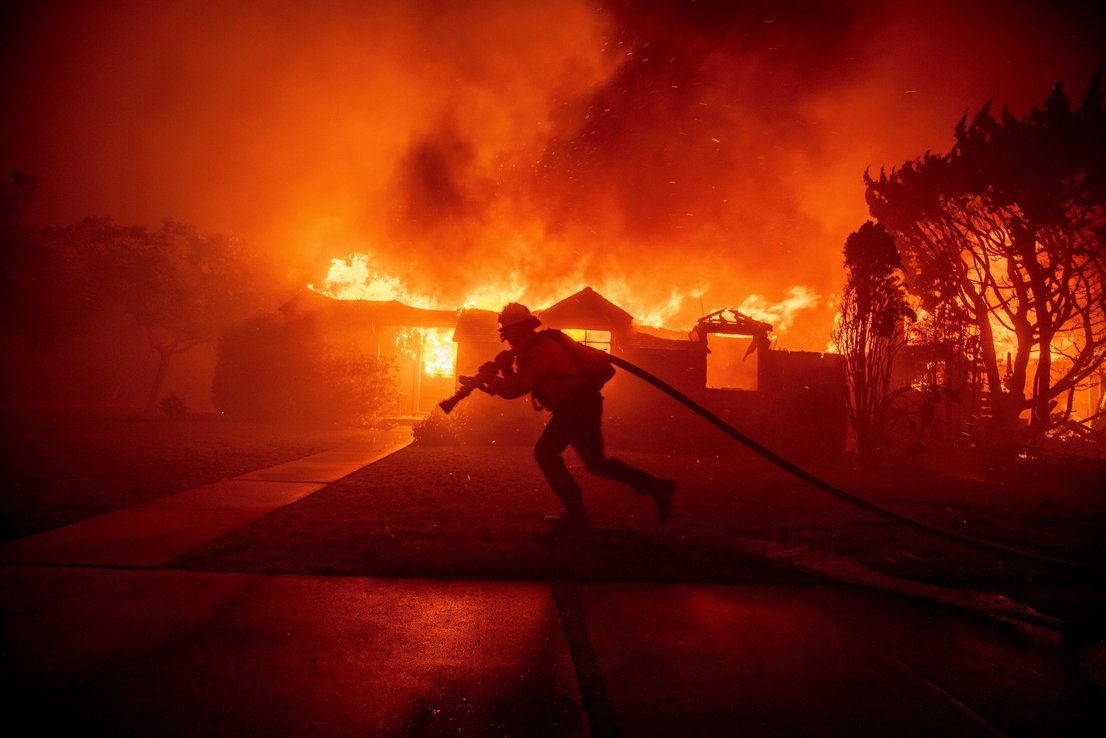
Helen Hague reports on the devastating wildfires that tore through Southern California in January
On 7 January, ferocious desert winds tore through parched terrain in southern California, powering two of the most destructive wildfires in the state’s history, turning neighbourhoods to ash, and leaving many thousands homeless.
First, a fire ripped through Pacific Palisades – one of the wealthiest enclaves in the United States, awash with celebrities. There, as firefighters fought huge blazes leaping from house to house, the emphasis was very much on rescue.
Propelled by gusts, embers were carried up to a mile in advance of the flames, setting other homes on fire. Earlier, 200 abandoned cars were blocking Sunset Boulevard, preventing firefighters from tackling the flames in Palisades. A fire department bulldozer soon shifted them so rescuers could get through.
Hours after the Palisades blaze first started, the Eaton fire swept through the foothills of the San Gabriel mountains, reaching the town of Altadena, leaving homes in ashes and lives in chaos as it spread rapidly through foothill neighbourhoods.
The first firefighters to arrive faced gruelling conditions and shifts of up to 48 hours – there were no seasonal staff. And gusting winds meant that many aircraft, which would usually have been spraying water on the billowing flames, were grounded.
The fires – and others that sparked and spread in the area soon after - wouldn’t have happened if there was still a “fire season” in Southern California. By January, rains would have doused the shrivelled vegetation and combustible scrub that fed the flames. It now looks like the fire season can last all year.
Firefighters’ homes burn
Firefighters who’ve spent their working lives saving people and property from flames don’t get special protection when wildfires blaze. At least twelve lost their own homes.
Pasadena Fire Department firefighter Charlie Hawes was fighting blazes close to his parents' home, where he lived with his two-year-old son Liam. He noticed that it was on fire.
"It was kind of like a fever dream where just everything was on fire," Charlie said. “I walked up the street and could see my parents' whole roof was on fire. I felt so helpless ... we're supposed to be fixers in this job, and that wasn't the case that night."
Hawes’s family escaped safely but the home was destroyed. "There's nothing. It just takes the breath out of you. The hard part is losing the sentimental things. (But) we're never gonna lose the memories."
Capt. Jerry Pugh is a 22-year veteran of the LAFD and his son, Adrian, is a probationary firefighter. Their home in Altadena was destroyed in the Eaton fire. Jerry said: “I’ve never seen anything like this; it’s like battling a hurricane, but instead of water it’s flames.”
Jerry recalled being woken up at 3:30 a.m. by the smell of smoke. He took a drive to investigate and was shocked by what he saw. “It was a pouring rain of embers — and that’s when I realized that the wind was blowing in the exact direction of my house. It very quickly got to the point where I realized we don’t stand a chance.”
He packed up his family and fled. Just a few hours later, his home was nothing but rubble. Jerry added: “I went back every morning for two to three days thinking I was going to find different results,” he said. “I was thinking, OK, maybe this is not true, maybe it’s a bad dream.”
“I just broke down”
George Baxter believed he had left his firefighting days behind when he retired after 30 years of service. Then the Eaton fire – which scorched more than 57 square kilometres east of Los Angeles before it was controlled – sent him on a final mission to save his own home in Altadena.
“I was probably the only person on my street that did not evacuate,” George told the LA Times. “But you know me, being a stubborn firefighter, I’m going to try to defend my property.”
Overnight from 11pm on 7 Jan, George stood in his yard armed with a garden hose and fought the flames. “My fence is on fire, the tree is on fire, my car tire is on fire,” he said. “So I’m running around like a chicken with his head cut off, and as soon as I put out one fire, the next one starts.”
The house across the street caught on fire, causing all of the guns stored inside to start exploding. “It felt like a war zone. All the rounds of ammunition are going off, and now I’m worried about getting hit by bullets.”
His nephew finally persuaded him to admit defeat and go to hospital, because his eyes were burning from the smoke, and he couldn’t see. When he saw photos of his home, he “just broke down in tears. I could not believe my house of 30 years was burned to the ground. ”
Apocalypse at Hollywood
Joe Ten Eyck heads up the IAFF’s Wildlife/Urban-Interface Fire Programs. It has a brief to help equip firefighters with the skills and equipment they need to tackle wildfires and save lives and property.
A former incident commander, Joe has been helping fight fires in California for forty years and has witnessed some extremely destructive fires in his long career. But even he wasn’t prepared for the “dark devastation” he encountered driving down Sunset Boulevard after the Palisades fire torched through town. “It looked like a nuclear winter – everything levelled, so much destruction”. A real-life apocalyptic drama was playing out near Hollywood, leaving gutted buildings, and abandoned cars.
Eighty five per cent of “fire communities” in North America are represented the International Association of Fire Fighters (IAFF), an influential union representing firefighters, emergency medical workers and rescue. Its 353,000 members also belong to affiliated unions in states and counties. It has 35,000 members in California.
More resources needed
In the wake of January’s catastrophic fires, the call for more firefighters and better resources is getting louder.
Freddy Esobar, president of the United Firefighters of Los Angeles City has long warned there aren’t enough fire fighters to cope with the increasing threat of wildfires. Just a month before the January fires, he told LA City officials that staffing in the Los Angeles Fire Department was “dire’’ – and that “someone will die”.
Now, calls for more staff and resources are ramping up. Los Angles Fire Chief Anthony Marrone told a press conference that the region’s firefighters were not prepared for “this kind of widespread disaster”. “There are not enough firefighters in LA county”, he said.
Health risks
The IAFF is also concerned about the potential health impacts on firefighters who responded to the California wildfires, and is working with the University of California to research the long term effects in those who attended.
Parallels with the FBU’s DECON campaign are striking. Announcing the research, the IAFF’s Chief Scientific Advisor, Dr. Derek Urwin, said: “We need to make post-exposure bio-monitoring routine after these events. Right now, we’re using grant funding to make this possible, but it’s critical that we integrate this kind of work into our standard approaches moving forward.”
The tip of an iceberg
The evidence is stark. Wildfires in California are growing in size and intensity, posing more risks to people and homes. Chillingly, people are starting to ask if the scale of destruction seen in LA in January will, like the year-long fire season, become the new normal.
Firefighters in the UK are already facing bigger wildfires, and the risk is growing, including in built-up areas. On 19 July 2022, the London Fire Brigade responded to 2,496 calls, and when commanders tried to increase attendance at incidents they were told that appliances were not available. Wennington, in east London, had 19 houses destroyed by wild grassland fires.
We could well be at the tip of an iceberg. As the climate crisis intensifies, extreme weather events will become more and more common. After 15 years of cuts, in which the UK fire and rescue service lost one in five firefighter jobs, the public is entitled to ask whether there are adequate resources to respond.