The government has announced that Police, Fire and Crime Commissioners will be scrapped. FBU general secretary Steve Wright explains what this means for fire and rescue services
It matters who oversees fire services. The Fire Brigades Union plays a crucial role in keeping chief fire officers accountable to firefighters and other fire service employees.
But who is their actual boss? At the moment, there are four different models. The Scottish Fire and Rescue Service sits directly under the devolved government. In some places, like London and Manchester, it sits under the elected mayor. In most brigades, it’s run by a fire authority made up of local councillors (in Northern Ireland, it’s called a ‘fire board’ and has a slightly different make-up) or in same cases, a county council department.
In four brigades, however - Cumbria, Essex, Northamptonshire, and Staffordshire – fire brigades have been rolled in with the remit of a Police, Fire and Crime Commissioner. That system was introduced in 2016, and the FBU fought hard against it from the start.
I’m happy to report that, last month, the government announced it was scrapping Police and Crime Commissioners (PCCs) outright from 2028.
A FAILED EXPERIMENT
In announcing the end of PCCs, the government called them a “failed experiment”. They were right. Firefighting is about humanitarianism – we help everyone, and we’re not there to enforce the law.
To protect the public, we need to be trusted and respected by everyone, including people who don’t, for whatever reason, trust the police. Pushing fire into the same governance structure as the police always ran the risk of blurring the lines between the two services.
It was also undemocratic. With a fire authority, decisions are made directly by elected local representatives. Police, Fire and Crime Commissioners, on the other hand, are much more powerful, and are paid big bucks – up to £100,000. They are often elected on low turnouts, and it is much more difficult to hold them to account.
REMOVE THE MOLD
Northamptonshire’s experience provides a good – and awful – example of how the system went wrong. In the summer of 2023, the fire service had a vacancy for chief fire officer. It fell to Stephen Mold, the Tory PFCC, to pick an interim chief.
He chose Nicci Marzec, his chief of staff, who had no operational fire experience. The FBU opposed the appointment. Firefighting is a highly technical, skilled profession; it is absurd to have a service managed by someone who has never fought fires before.
But it got worse. Marzec turned out to be a “close friend” of Stephen Mold, and quickly resigned when that story broke. Mold remained in post. In autumn, he decided to appoint yet another non-firefighter, Nikki Watson, a former chief police officer. The FBU opposed her appointment as well, without success. Then, in March 2024, it was reported that Mold had used abusive and sexist language to describe Watson while meeting with firefighters.
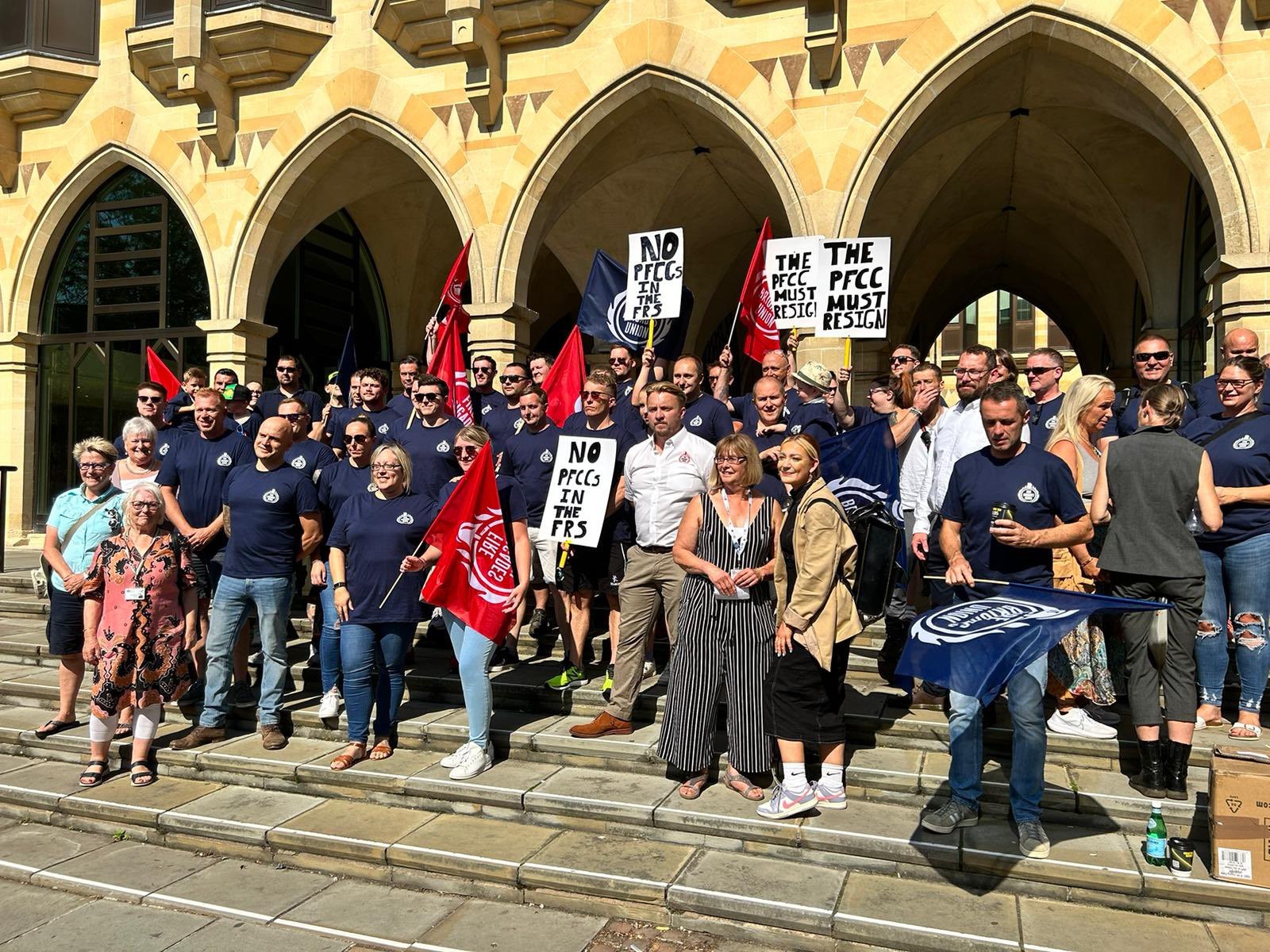
Throughout this whole period, the FBU fought to get rid of Mold (“Stop the rot, remove the mold” was the slogan). Firefighters held meetings, passed motions of no confidence, and launched petitions. They regularly protested outside meetings of Mold’s scrutiny panel. There was a public outcry.
But none of this got rid of him. It was only in March 2024 that he announced he would not run for re-election.
That is the reality of the PFCC model – it allows people like Stephen Mold to act with total impunity get away with murder. Under the Tories, it was Westminster government policy to expand this system. Now, it is being scrapped.
WHAT’S COMING?
The Labour government is planning big changes in terms of how fire services are governed. These changes are taking shape through the English Devolution and Community Empowerment Bill, which is currently being debated by the House of Lords.
There is a lot of detail in the Bill, but the broad direction of travel is that more fire services will be brought under the remit of elected mayors. The Bill gives ministers power to alter boundaries to make this happen.
For instance, the Tees Valley Combined Authority and the West of England Combined Authority don’t align geographically with fire authorities – so boundaries may shift to bring fire services under the mayor.
Two key principles will drive the FBU’s response to the proposals. Firstly, we need to end the fragmentation of the fire service. Having a patchwork of different governance models, and no national standards on crewing, equipment, training and response times, lets the public and firefighters down. We need national standards, and we need a rational governance model.
Secondly, we need democracy. It is no good bringing the fire service under the control of an elected mayor if there is no way for local councillors and elected representatives to hold them to account and correct their mistakes. We need real scrutiny and accountability, and FBU officials and members must use the structures to push their elected representatives.
Firefighters are the experts. Politicians need to listen.