
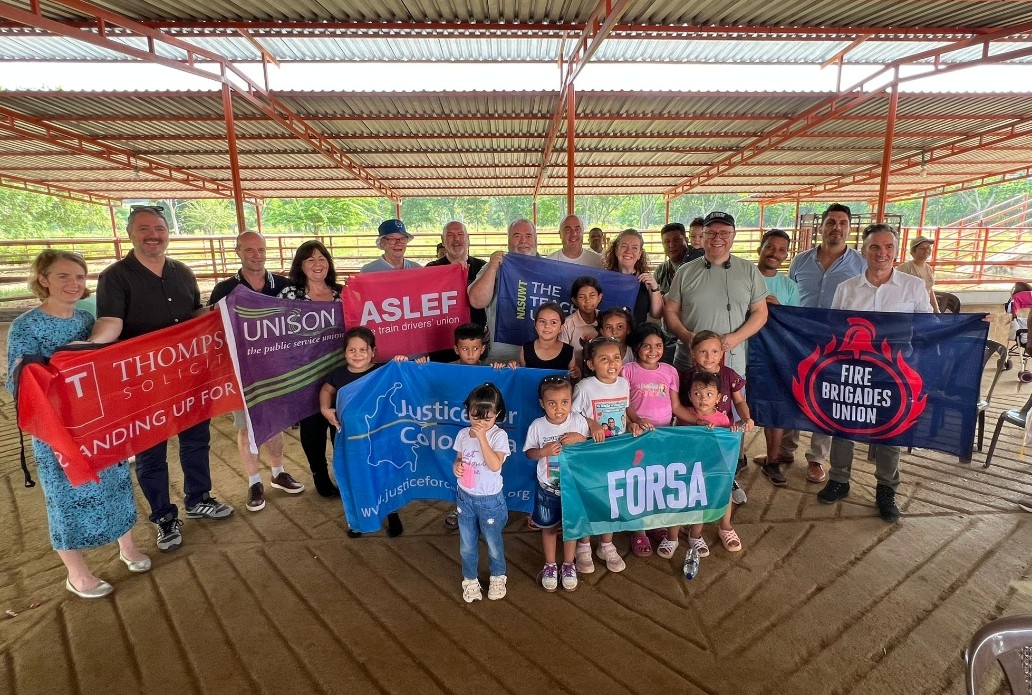
A delegation of trade unionists led by the Justice for Colombia campaign travelled to Colombia this November. National officer Mark Rowe reports back.
Justice for Colombia (JFC) was set up in 2002 by the British trade union movement to support Colombian civil society in its struggle for human rights, workers rights, peace and social justice.
Our delegation was made up of trade union members from the TUC, NASUWT, Forsa, Aslef, POA, PCS, Unison, Thompsons Solicitors and the FBU.
The purpose of our visit was both to learn and build solidarity. It’s vital that our movement continues to do so, as Columbia is still one of the world’s most dangerous countries for trade unionists. More than 3,000 trade unionists have been murdered since 1989 – more than in the rest of the world combined.
On the trip, we met with peasant and indigenous groups, political activists, human rights lawyers, the British and Irish embassies, sectorial trade unions, former guerrillas, and the Social Movement for Peace.
THE HISTORY
The roots of current conflicts trace back to 1948, when popular workers champion Jorge Eliecer Gaitan ran to be president – and was assassinated. Gaitan had promised to take on the oligarchy and deliver land reform to benefit the poor.
After his killing, protests erupted across Columbia, and the oligarchy cracked down hard. The decade that followed came to be known as ‘La Violencia’, with 200,000 Columbians – mainly peasant farmers – killed. This era of bloodshed ended when the Liberal and Conservative parties agreed to alternate in power.
Peasant workers formed self-defence groups, inspired by the Cuban revolution to fight for land distribution. An internal armed conflict between these groups and the army continued for decades, with some 500,000 civilians assassinated or disappeared. In the 1980s, large landholders, business leaders, and drug cartels banded together to create the paramilitary groups, supported by the military, that still wreak destruction today.
Land inequality remains one of the key drivers of conflict, with 65% of land still controlled by less than 1% of landowners.
Finally, a peace deal was agreed in 2016, with six main points designed to tackle these root causes and enable the modernisation of Colombian society. However, a far-right government failed to implement the peace deal between 2018 and 2022, leading to the conflict reigniting.
THE STATE NOW
President Gustavo Petro was elected in 2022, well known as an advocate for workers’ rights. He announced the “Total Peace” policy, promoting dialogue between armed groups – though this has been criticised for making slow progress. Some of the groups we spoke to talked of the need to build a grassroots movement for peace based in communities.
Now, presidential elections are scheduled for May 2026 – but Petro is constitutionally barred from standing again, despite his popularity.
Colombia’s political situation is made more difficult by the growing hostility of the United States. Trump is threatening to impose tariffs, which could deal a serious blow to the Colombian economy given that the US is by far its biggest export market.
The US has deployed forces near to Venezuela and has promised funds to undermine the government there, as well as in Nicaragua and Cuba, under September’s “America First” legislation.
US THREAT
There is no doubt that Trump is motivated by his opposition to Petro’s labour reforms. Unions we met with told us that these worker-friendly reforms are the first in recent history and included introducing regulation of the working week and overtime pay. However, Congress had been able to block measures that would further strengthen unions.
We also spoke to many people living in areas with ongoing conflict, and it is clear that the security of former guerrilla combatants remains a huge issue, with almost 500 killed since 2016. More must be done on this, as government representatives admitted.
PROGRESS
We also heard about transfers of land to peasants; the formalisation of their entitlement to the land they farm; and efforts to reduce inequality. Activists we met made it clear that an immense financial effort has been going into implementing peace, with 34 billion pesos spent on it in three years (compared with 14 billion over the previous government).
The Petro government has also pushed through pensions reform - currently only one in four workers qualify for a pension - healthcare and education reform, though many of these are being stalled in the courts.
Colombia’s landed elites, the multinational corporations stealing Colombia’s mineral and environmental wealth, and militarised politicians want a return to the old days - when their entrenched privilege and wealth continued the cycle of inequality.
Upcoming elections next Spring will have implications for the trade union movement across South America, and the world. Our fight for improved workers' rights in the UK grows stronger when we support the struggle for workers' rights everywhere.
Learn more and join the campaign: justiceforcolombia.org/