FBU members in Scotland are organising to save their service from some of the worst cuts seen in modern times and are calling for UK-wide support for their campaign, says Colin Brown, EC member for Scotland
Following the announcement of a five-year “flat cash” budget last year, the Scottish Fire and Rescue Service (SFRS) is planning to slash around 200 firefighter posts in a bid to save £11m this year. By 2027, it is predicted to have had its budget cut by a total of £36m.
These are the most savage cuts inflicted on any fire and rescue service since then mayor of London (and now-disgraced former prime minister) Boris Johnson took a wrecking ball to the London Fire Brigade (LFB), closing 10 fire stations and slashing more than 500 jobs.
Those cuts were inflicted using the same narrative and corporate language that we now hear in Scotland: that “efficiencies” are “based on evidence” and will mean no reduction in fire cover, no risk to communities, and no risk to firefighter safety.
Last month’s LFB report into the 2022 wildfires, which destroyed 16 homes in the suburb of Wennington, gives the lie to these claims: 39 LFB fire appliances were unavailable to respond due to crew shortages, putting homes, safety, and even lives, at risk.
This year alone the SFRS has announced that it will “temporarily mothball” 10 wholetime appliances, reduce high reach cover, and downgrade the crewing of the dedicated rescue boat on the river Clyde.
This rescue boat is one of the most vital lifesaving resources across any UK fire and rescue service. According to internal SFRS documents, rescue boats on the Clyde carried out 22 rescues in 2022 alone, alongside multiple other mobilisations for searches and recovery. The overwhelming majority of these undertaken by the dedicated crew now faced with downgrading.
DISHONEST
“Mothballing” is a dishonest way to present cuts. You can’t ‘mothball’ 200 firefighters; and even if the specific 10 appliances are dusted off and put back on the run at any point in the future, the likely reality is that 10 others will be removed.
The SFRS height strategy will reduce high reach capacity from 25 to 16 high reach appliances, and once they are gone, we know they are not coming back.
Public authorities have a duty to consult on major changes such as these at a formative stage. Given how far these proposals go, and that decisions already appear to have been made, it is hard to see how the SFRS plans are consistent with the Gunning Principles that outline how and when consultations must be carried out.
Merging Scotland’s eight fire and rescue services into a single service in 2013 was heralded as the only way to protect the front line, but as SFRS marks its first decade, FBU members see little to celebrate.
The latest cuts come on the back of a decade of austerity-driven erosion of services across Scotland.
Based on the Scottish government’s own figures, around £57m has been stripped from the annual budget for the service since 2012. Five of Scotland’s eight controls have closed with the loss of over 25% of control firefighters.
If LFB had to close 10 stations and slash 552 jobs to save £28.8m, how deep will SFRS have to cut to save £36m?
Over the same period, 620 wholetime, 318 retained and 140 volunteer posts have been lost – a total reduction of over 1,100 (or 14.5%) of firefighter posts across Scotland.
Add in the projected 200 for this year and Scotland is on course to exceed the disastrous cuts that have left other parts of the UK struggling to provide a meaningful emergency response to all incidents.
Scottish FBU members know that, based on Scottish government budget projections, there are more savage cuts and sweeping changes to duty systems and conditions still to come between now and 2027. If LFB had to close 10 stations and slash 552 jobs to save £28.8m, how deep will SFRS have to cut to save £36m?
MAXIMUM PRESSURE
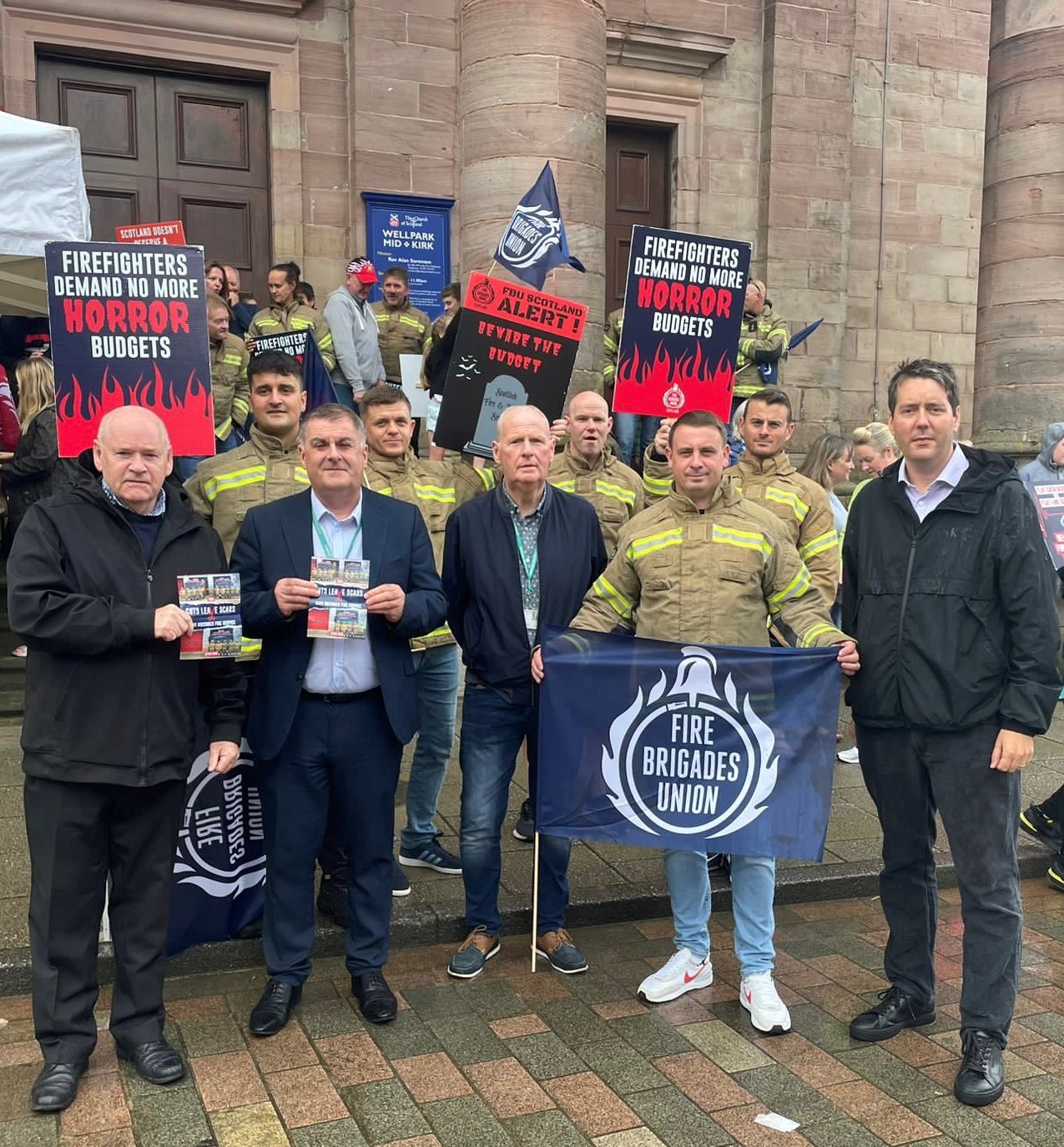
Members across Scotland have mobilised quickly and en masse to resist these cuts and exert the maximum political pressure on both SFRS managers and the Scottish government, with petitions, community engagement, lobbying events and demonstrations.
We have mobilised outside local council scrutiny committee meetings in Fife, Dundee, Perth, Hamilton and Greenock, with further events scheduled for Polmadie and central Glasgow.
Local and national press, radio and television coverage has been building and multiple parliamentary questions have been asked directly on the back of members and councillors writing to MSPs demanding meaningful investment to avoid these cuts.
All of this is building to a major UK-wide FBU demonstration. This will be held in Glasgow’s George Square on 24 August, less than a fortnight from when SFRS intends to implement the cuts.
To date, the response from the Scottish government has been depressingly predictable, with a stock statement repeated ad nauseam that “… it is right that SFRS continue to review its operations to ensure it is delivering value for taxpayers’ money.”
After more than a decade of failing to adequately fund the fire and rescue service, the Scottish government is running away from its responsibilities.
Our mobilisation in August will be a chance to push the government and SFRS to answer the demands of the public, MSPs and firefighters for meaningful investment and an end to the decade of cuts.