The latest red plaques to be unveiled honour the bravery, service, humanity and selflessness of firefighters who gave their lives in the line of duty over more than a century
Half a century ago, fire spread from a disused paint shop in Glasgow, ripping through nearby buildings. Battling through fire and smoke, firefighter Adrian McGill gave his breathing apparatus to a woman he was trying to save, as smoke filled her top floor flat. Neither sub-officer McGill nor Alice Mulgrew – the woman he was striving to save – survived.
A red plaque celebrating his bravery and service was unveiled in Glasgow at Maryhill fire station, near to where the fire broke out, exactly 50 years after Adrian McGill lost his life in the line of duty. Firefighters carried out up to 200 rescues during the blaze. Buildings collapsed and many had to be demolished later.
The unveiling came days after Bob Doris, MSP for Maryhill and Springburn, lodged a motion in Scotland’s Parliament remembering all firefighters across Scotland who lost their lives in the line of duty – and commending the Fire Brigades Union for its red plaque scheme. He praised the bravery of Adrian McGill and the red plaque as ‘’a fitting tribute to his memory”. Unveiling the plaque, Colin Brown, FBU executive council member for Scotland, spoke of sub officer McGill’s “heroism, gallantry and humanity”.
“Commemorating his bravery and sacrifice, we also honour and thank those who serve today,” he added.
SPLIT-SECOND DECISION
Seona Hart, FBU Scottish regional treasurer, paid tribute to his bravery. “He made a split-second decision – it was self-sacrifice on an almost indescribable scale”.
In the early seventies, Glasgow was known as “tinderbox city” because fires were so frequent and widespread.
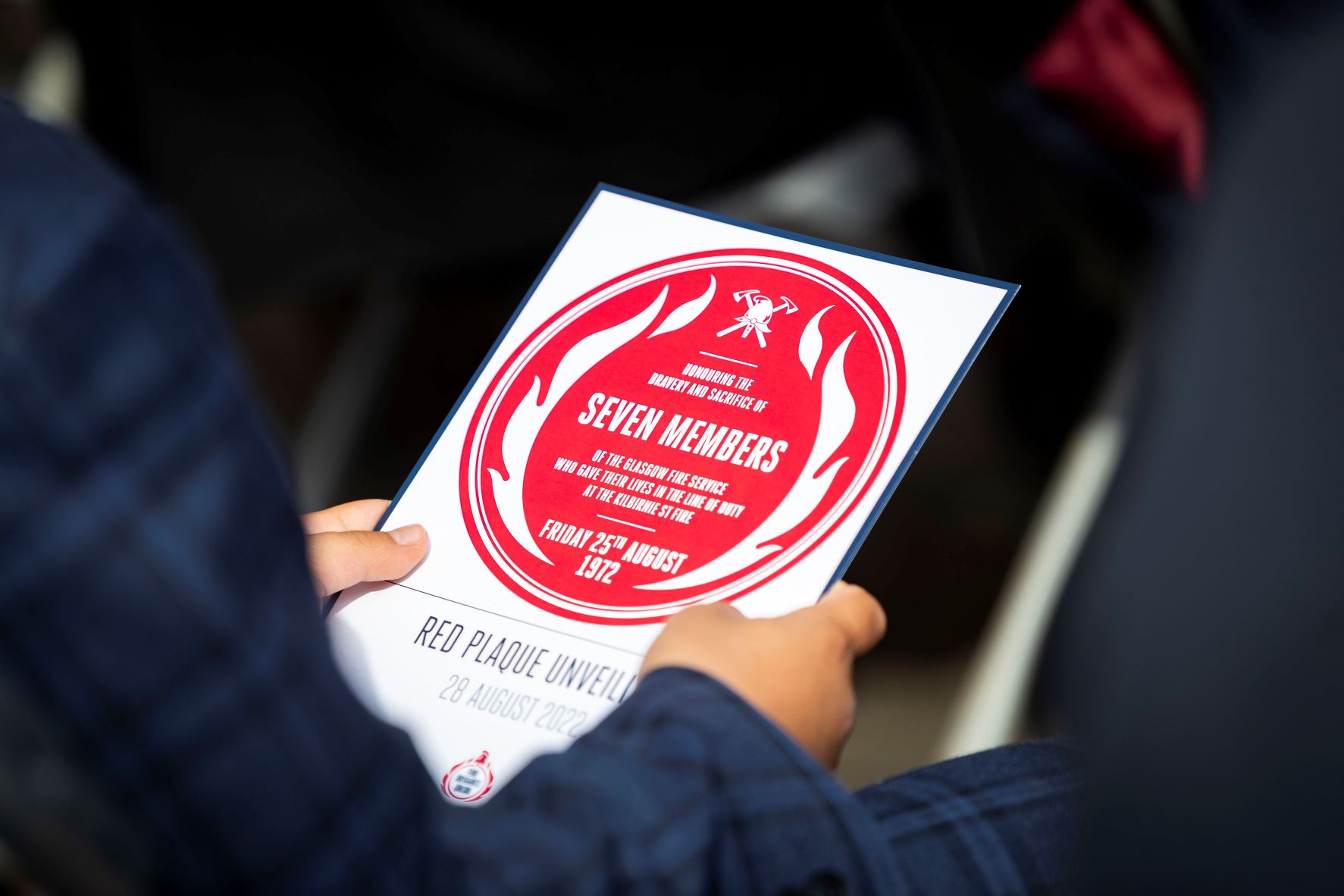
Less than three months before sub officer McGill lost his life, a textile warehouse fire in Kilbirnie Street killed seven firefighters. A stone memorial commemorating their sacrifice was erected in the city soon after.
He made a split-second decision – it was self-sacrifice on an almost indescribable scale
Fifty years on, in late August, a red plaque honouring the seven men who were killed was unveiled.
To date, seven red plaques have been installed in Scotland – and four more are already planned for next year.
They are funded by members and their friends and families who buy Firefighters 100 Lottery tickets. Seona Hart said: “It’s crucial we all support and continually promote the Firefighters 100 Lottery, both within and beyond our membership, to maintain funding for the DECON campaign and continue laying red plaques, to ensure our fallen comrades are never forgotten.”
IN THE LINE OF DUTY
The FBU did not exist when Superintendent John Johnson Hunt lost his life in the line of duty in 1905.
He died after a roof part fell when he was fighting a blaze at the Brooklands Hotel in Sale, Cheshire. He was a well-respected firefighter with 40 years’ service in Manchester and Sale. Thousands joined his funeral procession.
Before his untimely death he was renowned and lauded for many acts of bravery. In 1885 he saved a fellow firefighter’s life by crawling along a sixth-floor parapet in dense smoke. This led to several awards and even a popular song.
In October, his bravery and service were honoured with a red plaque on the site where he sustained the injuries that killed him – now an office building.
MORE RED PLAQUES UNVEILED THIS YEAR
Malcolm Kirton
William Fraser
Anthony Marshall
John Ogden
David Barnes
Neil Goldsmith
Edwin ‘Eddie’ Goodman
Frederick Willoughby
Alexander Drummond
Edwin James Booth
Lexie Wylie
Leonard McCartney
WHERE THE LOTTERY MONEY GOES
The lottery has raised an average of over £134,000 a year and more than £818,000 since its launch in 2016.
A total so far this year of £156k has been spent on good causes.
Around £15,000 went to red plaques and work connected to red plaque unveilings, including photo commissions and hosting the red plaque website.
The union’s DECON project was the main beneficiary from lottery funds – including Grenfell firefighters contaminants project – with continued research by the University of Central Lancashire.
A donation was made to the widow of firefighter James Bell and a small donation to Kensington station memorial garden following the death of member Josep Talens-Garcia.