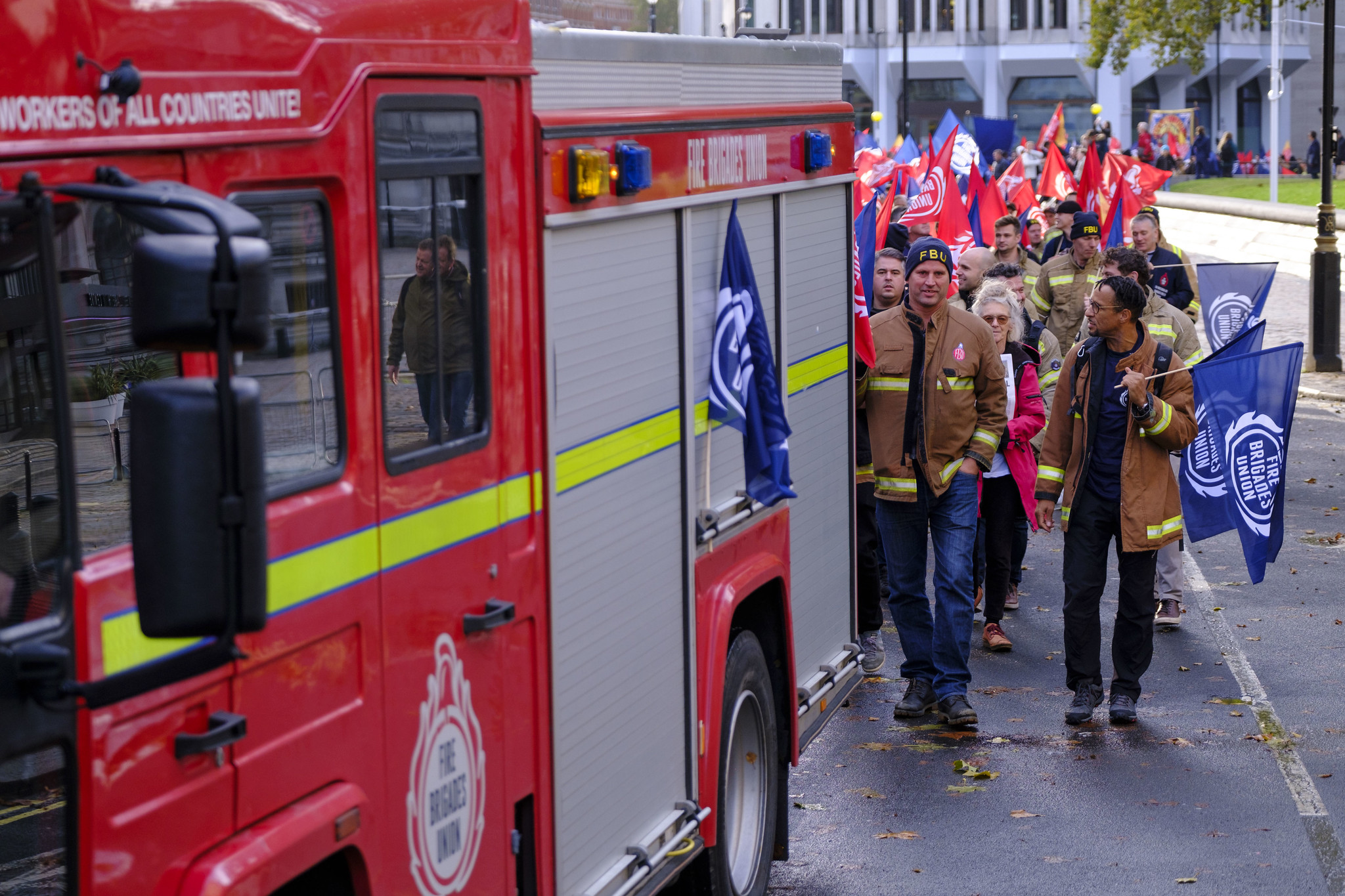
On Tuesday 8 October, firefighters from every corner of the UK will descend on Westminster to demand that the new government delivers a fire and rescue service that is fit for the future. FBU general secretary Matt Wrack explains why.
The result of the general election was a crushing blow for the Conservative party. It had its worst result – in terms of vote share and number of seats – since the foundation of the party in 1834. Liz Truss, Grant Shapps, Jacob Rees-Mogg and Therese Coffey all lost their seats. Firefighters who took strike action against the robbery of their pensions will be pleased to hear that Penny Mordaunt was also defeated in Portsmouth North, on a swing of 18%.
They deserved it. For 14 years, the Tories have trashed the UK. The Trussell Trust handed out 60,000 food parcels in 2010. In 2022-23, it distributed about 3m. Over the same period, the number of people sleeping rough more than doubled. NHS waiting lists are at record highs. Meanwhile, the richest 350 families in the UK have a collective wealth of £795 billion, equivalent to the GDP of Turkey or the Netherlands.
The end of Tory rule gives firefighters, and all workers, a huge opportunity
In the fire and rescue service, we lost one in five firefighter jobs between 2010 and 2024. Eighty-two fire stations and 17 emergency fire control rooms were closed. Progress on equalities and other important issues stalled, lacking resources and support. Pay and pensions were relentlessly attacked by millionaire Tory ministers.
FBU members should be proud of what we managed to achieve under unfavourable circumstances. We defended our right to negotiate pay and conditions directly with our employers.
Attempts to privatise parts of the fire service and further fragment it have been defeated. And on pay and pensions we won important concessions. The pay rises of 7% in 2022, 5% in 2023 and 4% in 2024 are significantly higher than in other areas of the public sector.
The end of Tory rule gives firefighters, and all workers, a huge opportunity. But to make the most of it, we must hold Labour to its promises and push it to deliver more. That is why the FBU has called for a national rally and lobby of parliament on Tuesday 8 October. If you can, please come – contact your regional secretary for details.
WORKERS’ RIGHTS
The FBU is affiliated to Labour in England and Wales, and we advocated for a Labour vote. We have many criticisms of Keir Starmer, and we have been robust where we have disagreed – on issues such as support for striking workers, taxing the rich, and investment in public services.
But Labour was founded to give workers a voice in politics, and as an affiliated trade union we could influence Labour’s manifesto through the party’s democratic structures. In advance of the election, we passed motions at Labour Party conference, pushed through Labour’s national policy forum, and met several times with Keir Starmer and senior shadow cabinet members.
Because of this work, and the work of other affiliated unions, Labour has been elected on a promise to defend collective bargaining in our sector, as well as addressing the need for better regulation of building safety.
The new government has also pledged to introduce a “New Deal for Working People”. Among other measures, this includes giving day-one rights on sick leave, parental leave and unfair dismissal; ban zero-hours contracts; and address fire and rehire.
Crucially for firefighters and fire control staff, the government also plans to scrap the Minimum Service Levels Act and other recent anti-union laws, overturning the de facto ban on strikes in the fire and rescue service in England.
STANDARDS
At present, the fire and rescue service is hugely fragmented. It is devolved in Scotland, Wales and Northern Ireland, and in England there are 46 different services.
The average response time for a first appliance is now nine minutes and 13 seconds, a full three minutes slower than in 1995. But how long it takes is a postcode lottery.
When the appliance arrives, there are no agreed national standards on how many firefighters will be on board, how they were recruited, what training they have, or what equipment they use.
It was not always this way. Until 2003, the Central Fire Brigades Advisory Council (CFBAC) existed. It was a committee, outlined in legislation, which brought together the FBU, fire chiefs and others to advise on national standards.
At this election, Labour promised to reintroduce national standards in the fire and rescue service, and to create a new body to develop them.
Labour held an official election campaign event in Dewsbury, where dozens of firefighters gathered to hear Yvette Cooper, now home secretary, outline the plans.
In the past, national standards safeguarded the fire and rescue service and those that worked in it. Now, they could be a way to make serious progress on training, recruitment, equalities, fire contaminants and more.
At our national rally and lobby of Westminster in October, we will be reminding Labour MPs of this commitment. We will urge them to move ahead with the plans promptly, and to put the new body on a statutory footing, like the old CFBAC.
Climate change and an ageing population mean that the fire and rescue service will be in higher and higher demand in the coming years. The UK will face increasing risk from fires, floods and extreme weather events.
But, just as the risks are increasing, austerity has pushed our service into crisis. Since 2010, central government funding for the fire and rescue service has fallen by around a third in cash terms.
We must push, cajole and encourage Labour to deliver for workers and the fire service.
To meet the challenges faced by the fire service, and to make serious progress on pay and other issues, we need to fight for investment.
The new government has been reluctant to commit to additional spending. But the UK is a wealthy country. It needs and deserves good quality, well-funded public services. We will be making that case powerfully at our October lobby.
COLLECTIVE STRENGTH
There are two mistakes that we must avoid following the general election result. One is to set our sights too low, or to think that all politicians are the same. The other mistake is to think that just because we have a Labour government at Westminster, we can rest easy, the truth is very different.
We know from bitter experience that governments of all stripes can do real damage. The Tories have left our service in crisis, but it was the New Labour government in 2002–3 that abolished national standards in the first place and removed establishment regulations, paving the way for cuts to firefighter numbers.
This Labour government can and should be different. Firefighters now have the best opportunity we have had in decades to shape the future of our service and win real advances.
But we can only do this through struggle – by demonstrating our collective strength and making our voices heard. Billionaires and corporations will be lobbying Labour to break its promises. So we must push, cajole and encourage Labour to deliver for workers and the fire service.
■ Join us in London on Tuesday 8 October.