FBU assistant general secretary Ben Selby explains why the FBU is fighting for 12 months (or 52 weeks) of full-pay maternity leave
How can it be right that a woman firefighter in Cornwall receives £15,000 less maternity leave pay than her equal in Derbyshire? Surely this is a case of stark inequality.
Yet, sadly, this postcode lottery is the reality that women face in the UK fire and rescue service.
Currently, maternity provisions are wholly inadequate, both in terms of occupational hazards and in terms of recruitment, retention and inclusion. That is why the FBU is firmly committed to addressing inequality in maternity arrangements.
Equality is a trade union principle and a priority for the FBU. That is why we launched our campaign Equality Matters in May this year to ensure that equality is part of everything we do as a union.
The FBU encourages all members to get involved in their union and actively encourages under-represented groups.
The FBU has three equalities sections: black and ethnic minority members (B&EMM), lesbian, gay, bisexual and trans members (LGBT+) and the national women’s committee (NWC). We are also beginning to better understand how we can support those with disabilities and neurodivergence.
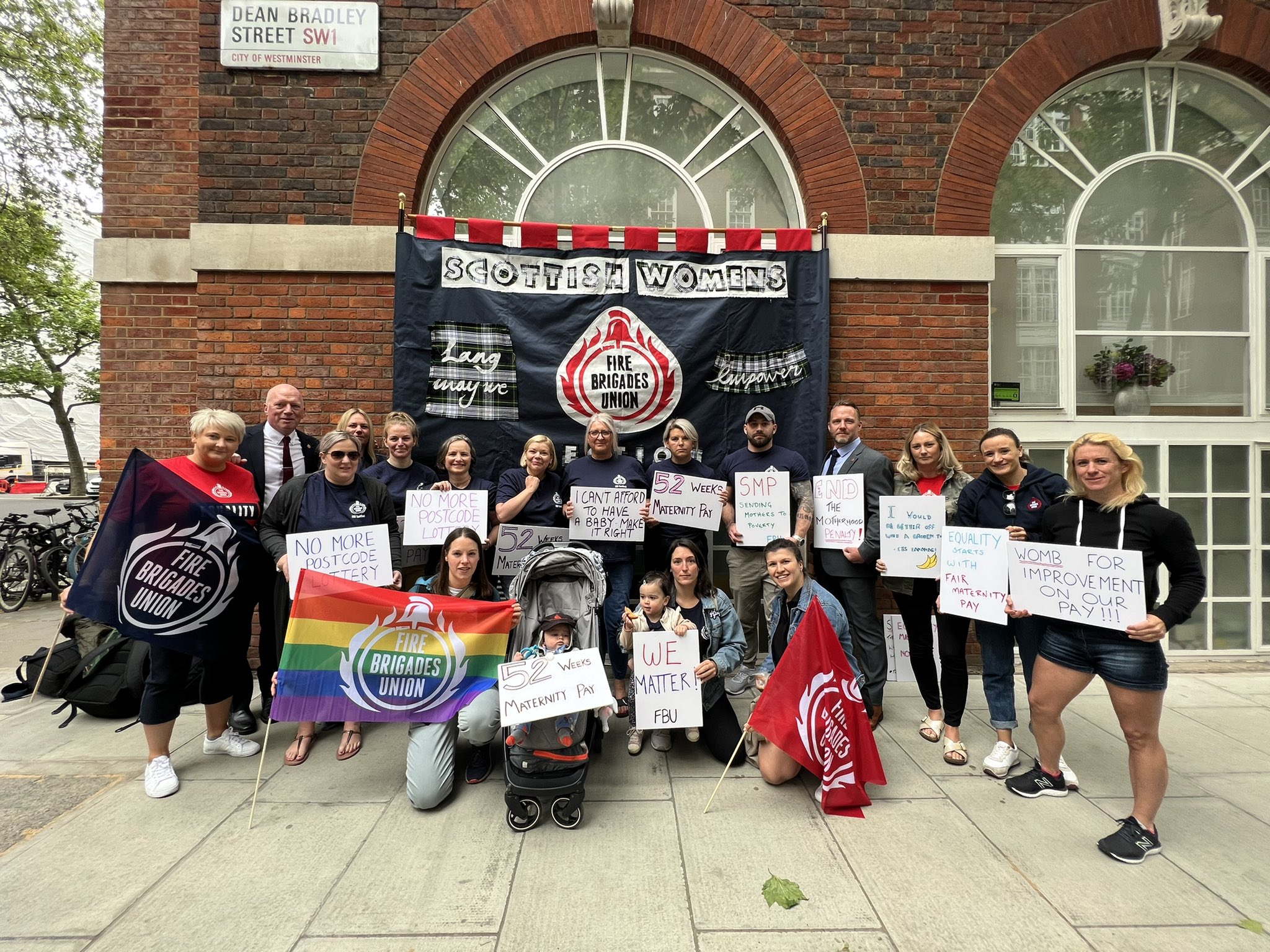
Fight for 52 seeks to address the dire imbalances in maternity provision across the UK and is an important part of the Equality Matters campaign.
BETTER MATERNITY PROVISION
On 2 May, the FBU wrote to UK fire employers at the National Joint Council (NJC), where the pay and conditions of operational firefighters and emergency control staff are negotiated, highlighting the obligation on national employers to address inadequate maternity provision in the service and to ensure that maternity provision in it is fit for purpose.
The union demanded – among other things – that all UK fire employers extend the current arrangement for maternity leave to 12 months on full pay following the date of birth. Pre-birth provisions must also be addressed, ensuring that expectant mothers are protected from the work-related exposures to fire contaminants.
These improvements must be reflected urgently in maternity provisions laid out in the Grey Book (the scheme of conditions which apply across the service).
For decades, the FBU NWC has outlined the stark disparities in maternity provision. In a fire and rescue service where the basic minimum is provided, women lose 10% of their pay as soon as they commence maternity leave. This only lasts for six weeks, after which they lose a further 40%. They then spend the rest of their ordinary maternity leave on half pay, which is usually 33 weeks.
The-soon-to-be-published Fight for 52 report details some of the awful situations that women firefighters have had to face.
One example displays the sub-optimal nature of current arrangements: “We currently have one of our women’s reps who is on maternity leave. Her provision is six weeks at 90% pay, then statutory maternity pay (SMP) only.
“To return to work and leave her baby after six weeks would have a massively detrimental effect on her mental and physical health. It would also mean that breast feeding would need to cease and the bond with the baby could be impacted.
“The reason I became a rep was because, when I was pregnant, I had one contract terminated, and my temporary promotion ended, all because I was pregnant (this was made clear in an email sent to me).
“I went off for a year and wasn’t told about a promotion opportunity, had no contact from line management to check on my welfare and just generally felt very let down. This contributed massively to me suffering with crippling post-natal depression.”
Firefighters put themselves on the line to protect the public. They deserve to be treated with dignity and respect, and to work in an inclusive environment.
An early return to work due to financial constraints has a detrimental effect on any new parent’s long-term wellbeing; this effect can be both physical and mental. This has been compounded by the cost of living crisis, which is pushing many people to their financial limits and forcing people into difficult positions.
The case for 52 weeks full pay and wider provisions is compelling. Across the country, women are being forced to return to work early after giving birth because they cannot afford to stay on maternity leave.
A lack of proper maternity leave puts mothers and babies at risk from fire contaminants. Inevitably, if your local fire service has bad maternity leave, firefighting will be a less appealing profession to join – or to remain in – to anyone who might get pregnant.
SERIOUS ACTION NEEDED
Ministers, the employers and chief fire officers need to be aware of the risks and rewards related to pregnancy and firefighting – not just in the first year but well beyond. Serious action is needed to ensure women firefighters have adequate maternity arrangements.
Women firefighters deserve better. Equality matters to the FBU. We will fight for 52 weeks of maternity leave on full pay everywhere in the UK.