National officer Mark Rowe spells out the current position on firefighters’ retirement prospects
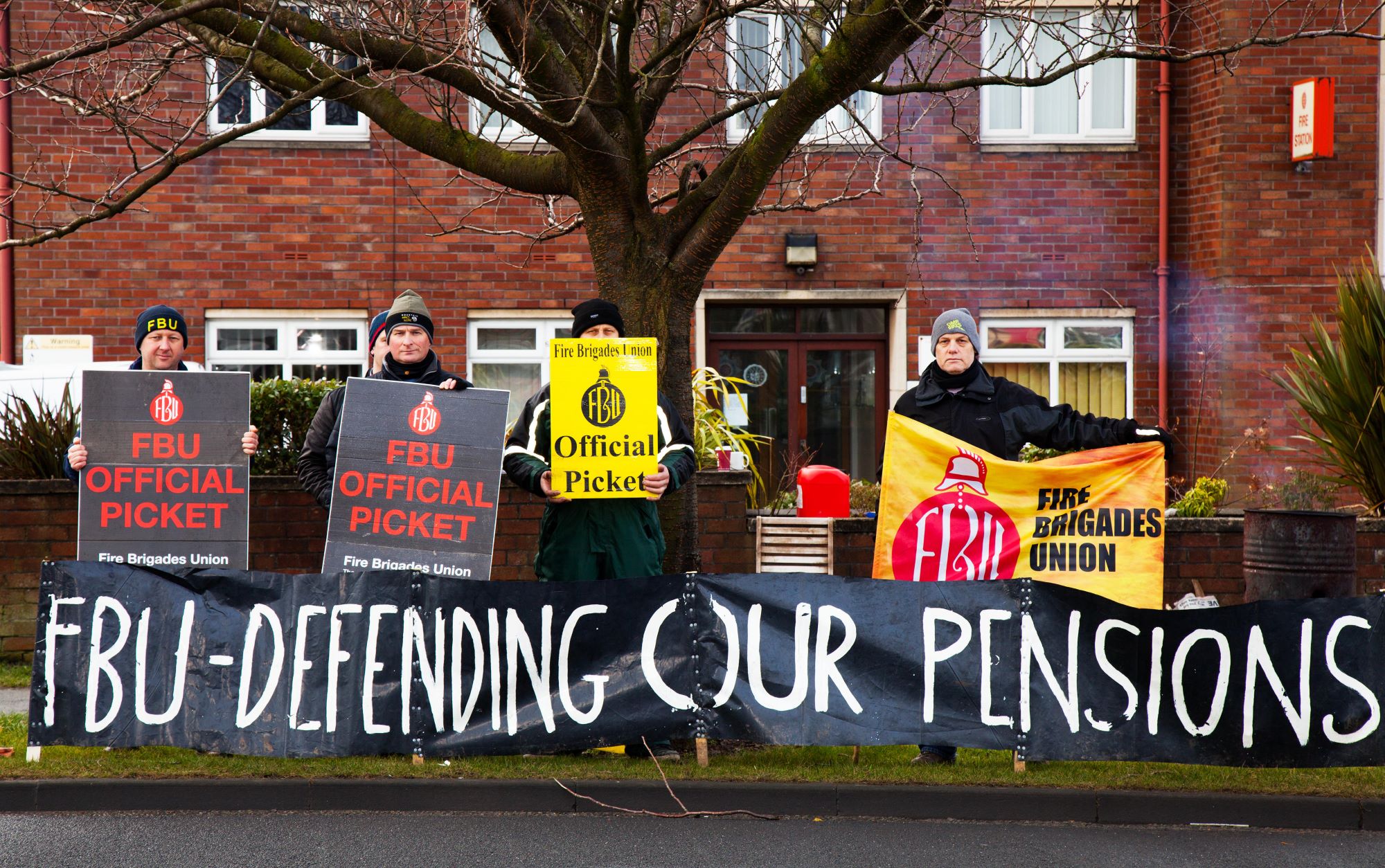
Pensions in the fire and rescue service have been under attack for decades. We are now expected to retire later and receive less. Much of this agenda has been pursued in the name of “modernisation”. Really, it is about squeezing workers – cuts. Firefighters’ pension contributions have always been higher than the average worker’s, but now the difference is even more stark. Civil servants earning between £32,000 and £56,000 pay 5.45% of their wages to their pension. NHS workers on a similar wage pay something like 9%.
But the average firefighter pays 12.9% in contributions. This is a major hit to our incomes and a significant portion of our pay. Realistically, due to the high risk nature of our work, opting out of the security of an occupational pension is not an option.
The FBU has fought hard on pensions. Since the industrial dispute of 2014-5, pensions have remained a priority. We have committed substantial resources to legal action on the subject and have repeatedly beaten the government in court.
VICTORIES IN THE COURTS
In December 2018, the FBU won a substantial case against the government when the Court of Appeal ruled that firefighters forcibly transferred under transitional protection arrangements into the newer, worse scheme, had the right to switch back to their old scheme if they chose to do so. This gave thousands of members seven years back in their legacy scheme.
The 2015 “reforms” meant that some members were forced to switch to the new scheme under transitional protection arrangements while others were not – and this difference (due to age) was in practice discriminatory. We took the government to court arguing precisely this. The FBU initiated more than 6,000 employment tribunal claims, charging that the changes amounted to unlawful discrimination on the basis of age, race and sex. We won, and our victory was finally upheld in June 2019.
In order to get compensation for members (injury to feelings claims), we have had to register mass employment tribunal claims, and members have registered to be a part of these claims via two surveys, one conducted in 2015 and another in 2020.
Legal action for the latter batch is still ongoing. In December, we reported in Firefighter that 9,000 members are due to receive at least £3,750 in compensation, with many receiving more.
COMPLEX PROCESS
We are now pursuing the task of getting that compensation paid as quickly as possible. Fire and rescue authorities have decided to process the payments themselves, and the process is complex: each claimant’s identity must be checked and they must individually consent to the payment.
In many cases, members will have to be tracked down if their email address has expired, changed, or was wrongly recorded or if they have changed address and/or contact telephone number.
The first set of pay-outs will only apply to the first set of claimants (who filled in the survey in 2015) and, for now, only to those in England and Wales. This is around 5,300 people.
Our pensions work is highly technical, and can make for a dry read, but it is of huge importance – we’ll continue to fight on it, and we’ll continue to keep you updated
The claims in Scotland and Northern Ireland remain stayed. Members there can expect, eventually, to receive the same level of compensation.
For the second batch of claimants (from the survey in 2020) the picture is complicated by the fact that the government is arguing that they should receive a lower level of compensation. The FBU is disputing this, and fighting for an equal settlement.
Some members will not remember whether they are a claimant, or which batch they are in, and a special email address is to be set up for members to enquire about this. A circular will be issued with details of how and when to do this so members are asked to await the circular before contacting the union.
THE ‘PENSIONS TRAP’
The “pensions trap” is a problem for firefighters who have membership of both the 1992 scheme and the 2015 scheme. Whatever choice they make at the age of 50 or 55, they stand to lose out. The example we provided to the Home Office is a member who has accrued 25 years’ pensionable service in the 1992 scheme by 31 March 2022. This member was born, say, in 1977 and joined the fire and rescue service in 1997 at the age of 20.
On 31 March 2022 they are therefore aged 45, and not yet able to draw their 1992 scheme benefits. Five years later, at the age of 50, they can do so. By that stage they have also accrued five years’ membership of the 2015 scheme.
However, whatever they do, they stand to lose tens of thousands of pounds because of the gaps between the schemes in terms of when they kick in and the lump sum calculations.
If they delay retirement so that they can benefit from both schemes, they will lose out. If the accrued 1992 scheme pension is worth £15,000 (this figure will vary), delaying payment by 10 years represents a loss of £150,000. But if they do not delay, they lose out in other ways – via massive deductions to their pension and complications with lump sums.
We know that our work around pensions is highly technical, and can often make for a dry read. But it is of huge importance to everyone in the fire and rescue service – we’ll continue to fight on it, and we’ll continue to keep you updated every step of the way.