
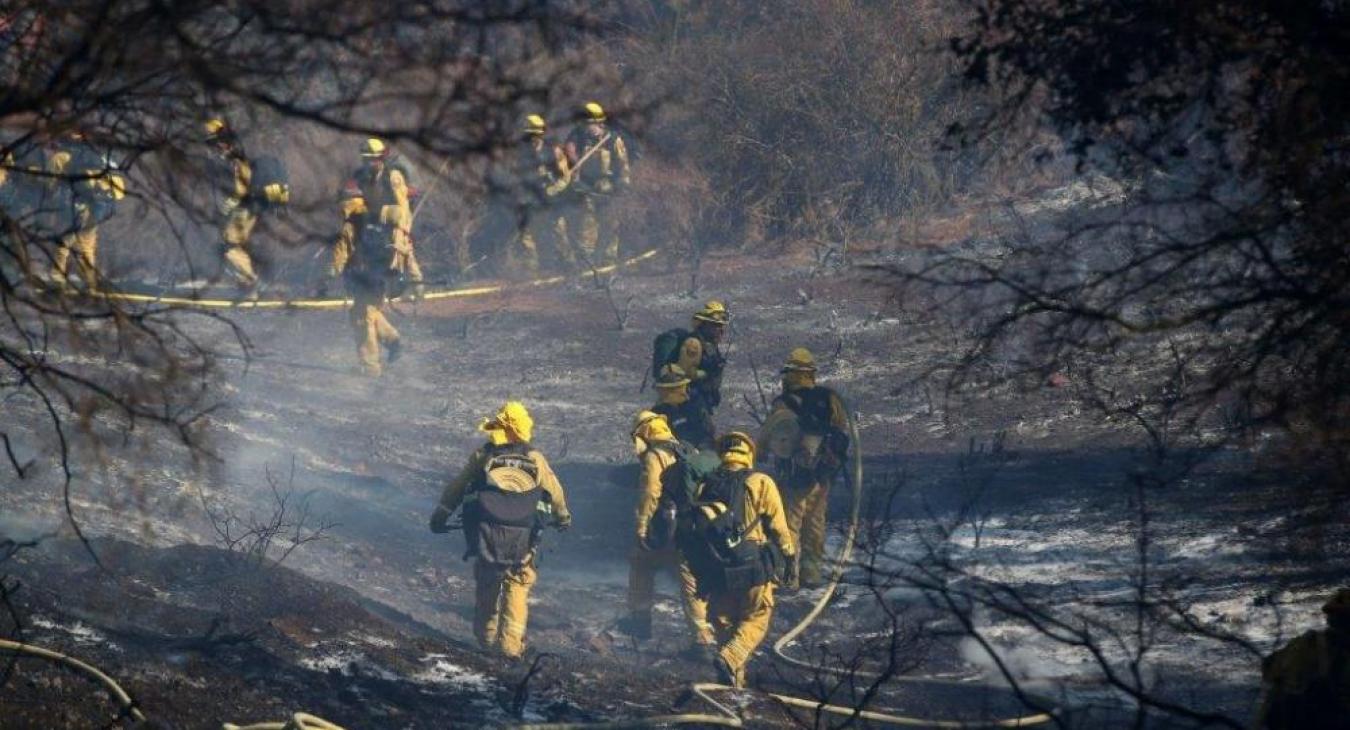
The ever-expanding wildfire season made a spectacular entrance when it arrived in California in the middle of the hottest August on record – when more than 11,000 dry lightning strikes tore down from the skies - sparking wildfires on parched vegetation.
It is turning out to be a record-setting year – but not in a good way: five of the six largest fires in the Golden State’s history, a record 4.1 million acres burned by early October, a million by the state’s first ‘giga-fire’ in modern times. These million acres burned when the mighty August Complex (the name given to the fire) grew and grew, joined by wind-driven smaller fires, as it rampaged across drought-stricken land.
In late October, two firefighters were critically injured and 90,000 people forced to evacuate in Orange County as wind-whipped flames raged through dry land. High winds kept air tankers from dropping water and fire retardant on blazing vegetation. This left 500 ground crew firefighters, including the two who became badly burned, to fight the fast-moving flames.
For California’s committed professional firefighters, the pace has been unrelenting. Not for the first time, they have found themselves on the climate change frontline - as the temperature creeps up, the air gets drier and the winds ever fiercer. This is the perfect recipe for the huge and damaging wildfires that have raged through the state and beyond this year - setting the West Coast on fire.
As Brian K Rice, president of the 30,000 strong California Professional Firefighters, puts it “Megafires are now the new normal” in California - and “firefighters have been stretched thin each time spending weeks away from families and loved ones”.
There have been near apocalyptic scenes – beyond the usual charred trees and abandoned burned out vehicles. In early September, fire-choked skies over San Francisco Bay turned an eerie orange as ash-laden smoke blocked out the sun. Air quality plummeted. Swept along by the jet steam, the smoke could soon be seen on the US East Coast and as far away as Europe.
By the end of September, flames were sweeping through the affluent wine regions in northern California, leading, as in other parts of the state hit by wildfires, to mass evacuations. Vineyards and wineries were torched, leaving grape crops so contaminated many wine growers dropped plans for a 2020 vintage. There’s never been much call for wines with notes of ash, smoke and an undertow of plastic particulates.
The huge rise in people moving into areas prone to wildfires in recent years has ramped up risk, says wildfire policy expert Char Miller. “Where people go, fires erupt… we’re complicit in the very fires we think are out there in nature”. Rising house prices in big towns and cities have fuelled more self-building in forests and other “wildfire urban interface communities”.
The deadliest and most devastating wildfire in the state’s recent history tore through the forest town of Paradise in November two years ago. It was sparked by faulty power lines. Raging flames destroyed buildings and killed 85 people.
Justin Silvera, a battalion chief with Cal Fire, the state’s firefighting agency, lived in Paradise – as did seven members of his own family who lost their homes. He and his crew have worked 64 hours at a stretch over recent months, snatching 20-minute naps. “I’ve been at this 23 years and it’s the worst I’ve ever seen,” he said. “Typically, we are able to attack - air tankers, choppers, dozers. But these conditions in the field, the drought, the wind, this stuff is just taking off. We can’t contain one before another erupts.”
Days after the August lightning strikes, Darrell Sales, a firefighter with the San Jose Fire department, lost the home he bought with his partner a year ago in the Santa Cruz mountains. It was razed to the ground.
Firefighter Geoffrey Keller, and his wife Allegra “lost everything they owned” when fire swept through the home Geoffrey built just last year in Last Chance Lane - the flames were just half a mile from their driveway before they evacuated. Keller was back at work fighting fires within two days. He found it “really therapeutic and cathartic to get myself back out there”.
Random acts of carelessness play a devastating role in spreading fire. As Cal Fire, the state’s firefighting agency – also known as the California Department of Forestry and Fire Protection - is always reminding citizens: sparks and embers cost lives.
Take the El Dorado fire which started in early September. It began with a ‘gender reveal’ party in the San Bernardino Forest, when the temperature was nearly 20 degrees above normal. Celebration turned to calamity when the pyrotechnic device used – blue smoke for a boy, pink smoke for a girl - delivered sparks, igniting parched vegetation on the forest floor. By the beginning of October, the fire had scorched more than 22,700 acres across two counties, injuring thirteen people.
And tragically killing a man who had spent his working life trying to keep wildfires at bay - elite firefighter Charlie Morton, who led the Big Bear ‘Hot Shot’ squad battling blazes in the San Bernardino National Forest for 14 years. Colleagues, family and friends celebrated his life at a memorial service. For all Californian firefighters on the frontline his death was a grim reminder that simply doing your job can lead to the ultimate sacrifice.
Firefighters and their families know battling wildfires is hazardous – to both physical and mental health. During a wildfire, soot, smoke, ash and fire-retardant chemicals spread through the fire zone. Houses are full of plastics, metals and man-made fabrics – which can prove toxic when they burn.
Megafires swept through California in the midst of the Covid-19 global health crisis, creating two state emergencies. By the end of October, more than 900,000 Californian citizens had been infected, and over 17,000 killed by the virus. Only New York state and Texas had more deaths. Professional firefighters and their families are not immune – depleting already overstretched crews and adding yet another stress to the job.
In Californian jails, the virus was killing both prisoners and staff – leading to the early release of many low- risk prisoners – including hundreds of volunteer ‘inmate hand-crews’ who the state has relied on for decades to cut fire-lines to halt the spread of approaching wildfires.
In the midst of one of the most damaging wildfire seasons in recent history, with ‘Mutual Aid’ firefighters from Alabama to New York helping out – the spotlight was on the controversial practice. Opinion is sharply divided. Brian Rose, championing properly paid and resourced professional firefighters, says using inmates as hand-crews is ‘morally unethical’ and the ‘antiquated’ scheme should be abolished.
Others say it a chance for prisoners to “give something back”. New legislation will for the first time allow inmate hand-crews to apply for the job they’d been doing for a pittance as prisoners. A new entry-level “hand-crew” job is being created. But with fierce competition for firefighting jobs, it may not prove an easy route from jailhouse to firehouse.
Numerous studies in recent years have linked bigger US wildfires to global warming from burning coal, oil and gas. Rising temperatures and the climate crisis has made California much drier and more flammable.
State Governor Gavin Newsom pledged to take further steps to “decarbonise” the economy as he toured Butte County after the North Complex Fire ripped through the town of Berry Creek – where some made homeless when fires raged through Paradise saw their new homes destroyed. New legislation requires all new passenger vehicles sold in California by 2035 to be zero carbon.
In the UK, the Labour party is now committed to achieving net zero carbon emissions by 2030 as part of a Green New Deal – a move championed by the Fire Brigades Union. UK firefighters find themselves dealing with more floods and wildfires as the climate heats.
As California’s firefighters brace themselves to deal with the destructive effects of climate change, Governor Newsom has a message for those who haven’t yet grasped the urgent need to cut carbon. He regularly tweets out ‘CLIMATE CHANGE IS REAL’. And California’s frontline firefighters are grappling with the fallout - on each exhausting extended shift away from home, attacking wildfires as they blaze across parched terrain.