In the Gaza Strip, where the relentless grind of war has erased homes, neighbourhoods, and almost entire cities, firefighters have been lifelines in a collapsed world.
Gaza based journalist Ghada Abdulfattah presents a snapshot of life on the run in Gaza during the last two years, in an extract from an article published by The New Humanitarian this July.
This story is an extract from an article originally published by The New Humanitarian in July 2025
Before the war, Gaza’s firefighters mostly responded to routine emergencies – house fires, car accidents, and individual medical crises. During previous wars – in 2008, 2012, 2014, and 2021 – they worked under difficult conditions, but nothing prepared them for the intensity, scale, duration, and relentless pace of the Israeli assault that began following Hamas’ October 2023 attacks into Israel.
BOMBED OUT RUINS
For over 20 months, Gaza’s firefighters have spent their time carving tunnels through bombed-out ruins trying to find survivors – and the bodies of people who have been killed – trapped underneath. During that time, Israeli airstrikes, bombardment, and ground operations killed nearly 55,000 Palestinians in Gaza and injured over 125,000, according to the Ministry of Health – although the true toll of the war, including deaths from disease, denied medical care, starvation, and other conflict-related causes, is likely significantly higher.
The firefighters brave cratered roads when the sky rains bombs, racing to the scenes of airstrikes to quench the fires they spark with barely enough water.
“We used to save people from accidents,” said Yasser Amer, a 27-year-old firefighter. “Now, we’re pulling children from the debris.”
UNDER FIRE
In July, The New Humanitarian spent two days with Amer and the team of firefighters he is a part of at their base in al-Mawasi, along Gaza’s southern coast. Multiple rounds of Israeli evacuation orders and assaults on cities over the course of the war have forced hundreds of thousands of people to flee here. The area is covered in tents housing displaced people as far as the eye can see.
The team of firefighters is part of the Palestinian Civil Defence, a civilian agency – affiliated with Gaza’s Ministry of Interior – that is responsible for providing emergency and relief services. The Civil Defence force has been a key source of photos, videos, and initial death tolls following airstrikes during the current war, and Israel has sought to delegitimise the information it provides due to its affiliation with Gaza’s Hamas-run government. But the Civil Defence workers The New Humanitarian spoke to said they are impartial humanitarian workers who carry out their lifesaving work in accordance with international humanitarian law.
In a war that has seen the indiscriminate – and sometimes allegedly intentional – killing of aid workers, journalists, and medical personnel, members of the Palestinian Civil Defence have not been spared. By July, a staggering 113 have been killed – including six who were shot dead when Israeli soldiers massacred 15 first responders in Rafah on 23 March.
EARLY SHIFT
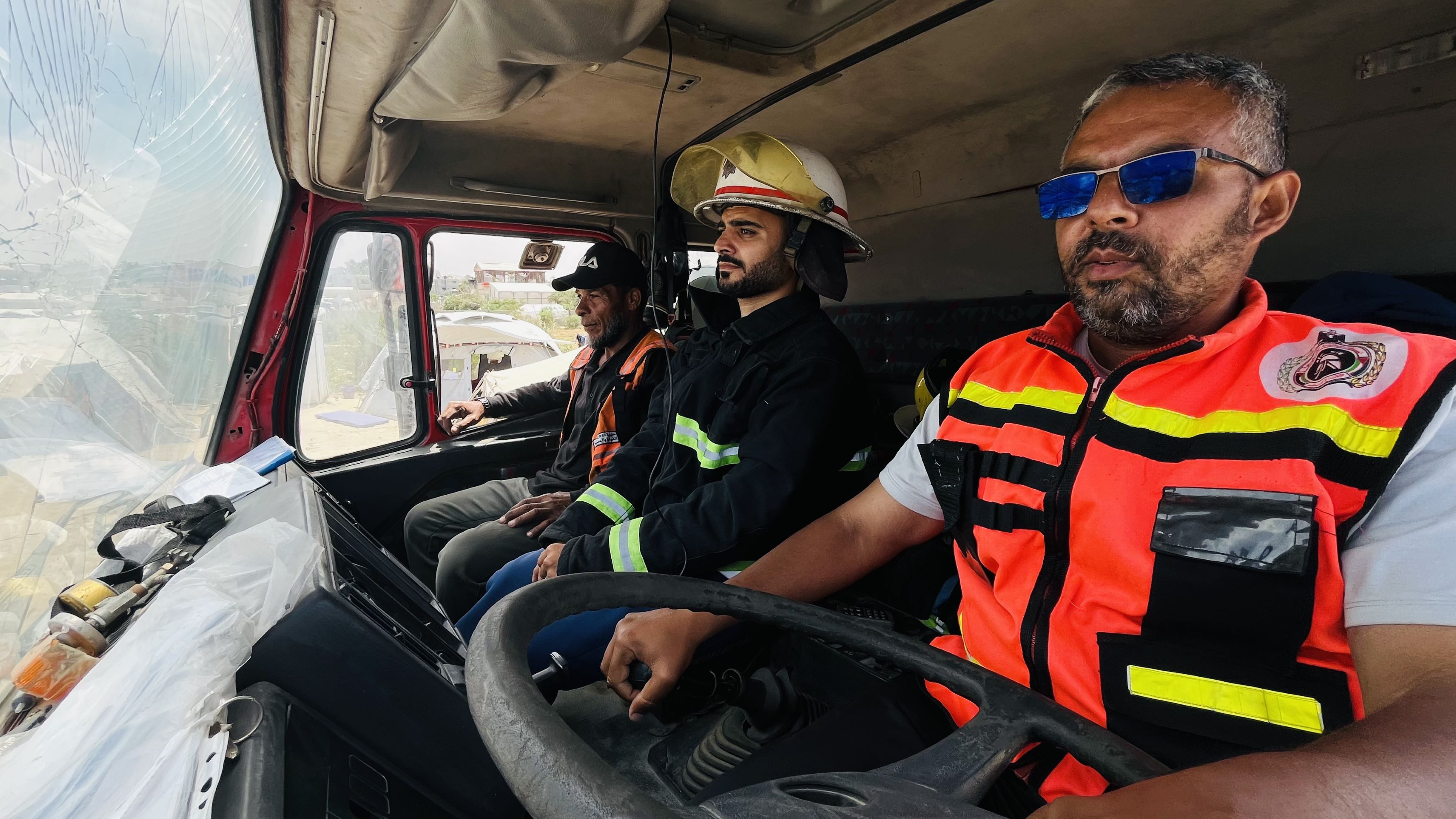
On the first morning, the leader of the team, 44-year-old Ahmed Radwan, began his shift early, as he always does, by checking the two firefighting vehicles at the group’s base in al-Mawasi.
Broad-shouldered and with an easy smile, he joked with his team members and with children on the adjacent street as he went about the morning. A veteran firefighter of over 18 years, he was born in Rafah and raised his four children there – until he was displaced and moved just a few steps away from where he now works.
The base itself is no more than three tents pitched together, improvised under the open sky. Uniforms, spare clothes, and towels are hung on lines strung between poles and tent stakes, drying in the sun. A small shack made of palm leaves sits close to the street. This is where the team gathers and boils tea over an open fire. They share jokes about their meagre salaries, which all too frequently arrive late, stories from days spent on the front lines, and wishes for the bloodshed to end.
“THEY’VE SEEN HELL”
As Radwan made his morning rounds, he tapped the tank of one of the red fire trucks. “There’s enough water,” he said, “but the battery doesn’t work.”
Each truck has a unique identification code on its roof and sides, which the firefighters share with the Israeli military through the International Committee of the Red Cross (ICRC) in an effort to avoid being targeted.
He continued to clean the truck’s hood, tightened loose wires, and prayed it would not fail them. “These vehicles are outdated and have not been maintained,” he said, pointing to the truck’s broken windshield, cracked by an Israeli airstrike. “They’ve seen hell.”
Since the war began, no new fire engines have been allowed into Gaza, and spare parts are extremely scarce. Even before then, the Israeli blockade, imposed since 2007, made maintaining the vehicles difficult, with simple pieces of equipment, like jumper cables, hard to come by.
TOTAL SEIGE
Since October 2023, the wear and tear on the vehicles and scarcity of resources for maintenance has become exponentially worse. The hardest period has been since the beginning of March this year, according to Radwan, when Israel imposed a total siege on Gaza, intensifying the shortage of supplies.
During the massacre in March, Israeli soldiers crushed a fire engine and buried it in the sand – along with five ambulances and a UN vehicle. Radwan knew the six Civil Defence workers who were killed well. “We didn’t lose one or two – we lost a whole shift,” Radwan said, his voice flat.
“It’s not easy to see how our lives have become so cheap – how we’re left unprotected, even though we should be [protected], like rescue workers everywhere else in the world.”
CHASING BOMBS
As the morning stretched on, some of the firefighters chatted in the palm-leaf shack, drinking tea. Others lounged inside one of the tents. Suddenly, a loud explosion broke the relative calm. The team immediately snapped into action, loading into one of the fire trucks without waiting for an emergency call.
Internet and phone services have been cut off at different times, plunging Gaza’s 2.1 million residents into complete communication blackouts.
“We’ve come to depend on the eye and on the ear – on what we see and hear,” Radwan said. “The sound of the explosion, the direction of the smoke, that’s how we find the next strike.”
IN THE DARK
“In the absence of communication, we had to improvise,” he said. “We began sending an ambulance to the hospital, where it would wait for wounded people who arrive first to tell us where the airstrikes had occurred.”
On the day of The New Humanitarian’s visit, the loud explosion, a plume of smoke rising into the sky, and crowds immediately rushing in the direction gave it away. It was coming from a cluster of tents behind the Kuwait Specialised Field Hospital – nearly two and half kilometres from the base.
When the firefighters arrived on the scene, the fire was raging. Thick black smoke billowed into the air, people were running in all directions, and a man was dragging two children out of one of the burning tents.
WATER SHORTAGE
At the scene, Amer started giving instructions. With limited water in their tanks, the firefighters worked quickly to isolate the fire from other highly flammable tents nearby. They doused the missile debris, cylinders of cooking gas – most of them empty – and anything else that could potentially spread the fire in water.
With access to water severely limited, they were careful to ration their supplies, saving as much as possible for the aftermath of the inevitable next strike. Using shovels, they dug into the sandy soil and used it to extinguish the flames.
“It’s a race against catastrophe,” Radwan said. “If we use all the water at once, we run out before we reach the source of the fire. If we go slow, the fire spreads.”
Once the fire was put out, the firefighters donned oxygen tanks to search the burned-out tents and the inside of a one room building housing displaced people. “We searched every corner – but found nothing. Still, parents were screaming: ‘Where are the children?’”.
CARRYING MEMORIES
The following day, the firefighters were back at their base, prepared to respond to another emergency. Conversation drifted to past incidents. The hardest part, they said, isn’t the fire but what comes after. Many of the firefighters carry memories of the airstrikes they have responded to, down to the smallest detail.
Amer recalled one of the first incidents he responded to after October 2023. A house had been hit by an Israeli airstrike, reducing it to a pile of fallen concrete and twisted metal. Somehow, a 15-year-old boy named Hammouda had survived. Buried under two and a half metres of debris and cradled in his mother’s arms, he clutched a phone in his hand that he had managed to use to call for help. His mother was already dead.
“I could hear him the whole time. He kept saying, over and over, that he couldn’t breathe.”
HANDS AND SHOVELS
There was no heavy machinery to use for excavation – just iron rods, a few shovels, jacks, and the firefighters’ trembling hands. For six hours, Amer and the team he was working with dug with these basic tools, guiding an oxygen tube and water underneath the rubble to keep the boy alive. Any misstep or shift in the debris could have crushed him. “But he never panicked,” Amer recalled. “He held on.”
Airstrikes thundered in the distance, and at one point, Amer had to leave to respond to another house that had been hit. Radwan and Samir Bahabsa carried on with the excavation until Hammouda was finally pulled up alive.
LAST-HOPE-GIVERS
After every strike the firefighters respond to, chaos follows. “We see people at their worst moment,” said Said Qishta, a 25-year-old member of the team. “And still we have to keep moving. From one fire to the next. From one scream to another.”
Qishta narrowly escaped being killed in the massacre at the end of March. He used to work the same shift as the firefighters who responded that night. Two days before the massacre, he had rotated to work out of a different location.
“I should have been with them that night,” he said, of his former team, his eyes cast downward. “But I had moved to a new location. Just luck.”
LITTLE RELIEF
Qishta recently had his first child – a baby boy. He named him Adam, wishing for him to have a better and brighter life than what his father has witnessed.
After each mission, Amer calls home. “I’m fine. All is good. Stop worrying about me,” he said to his wife on the phone after returning from responding to the missile strike on the tents behind the Kuwait Specialised Field Hospital. “Let me talk to Sila,” he added, softly. His daughter’s voice came through. “I’m fine, Baba,” she said. Amer smiled for just a moment. Then he put his helmet back on.
--
The New Humanitarian puts quality, independent journalism at the service of the millions of people affected by humanitarian crises around the world.
Find out more and read the full article at www.thenewhumanitarian.org