
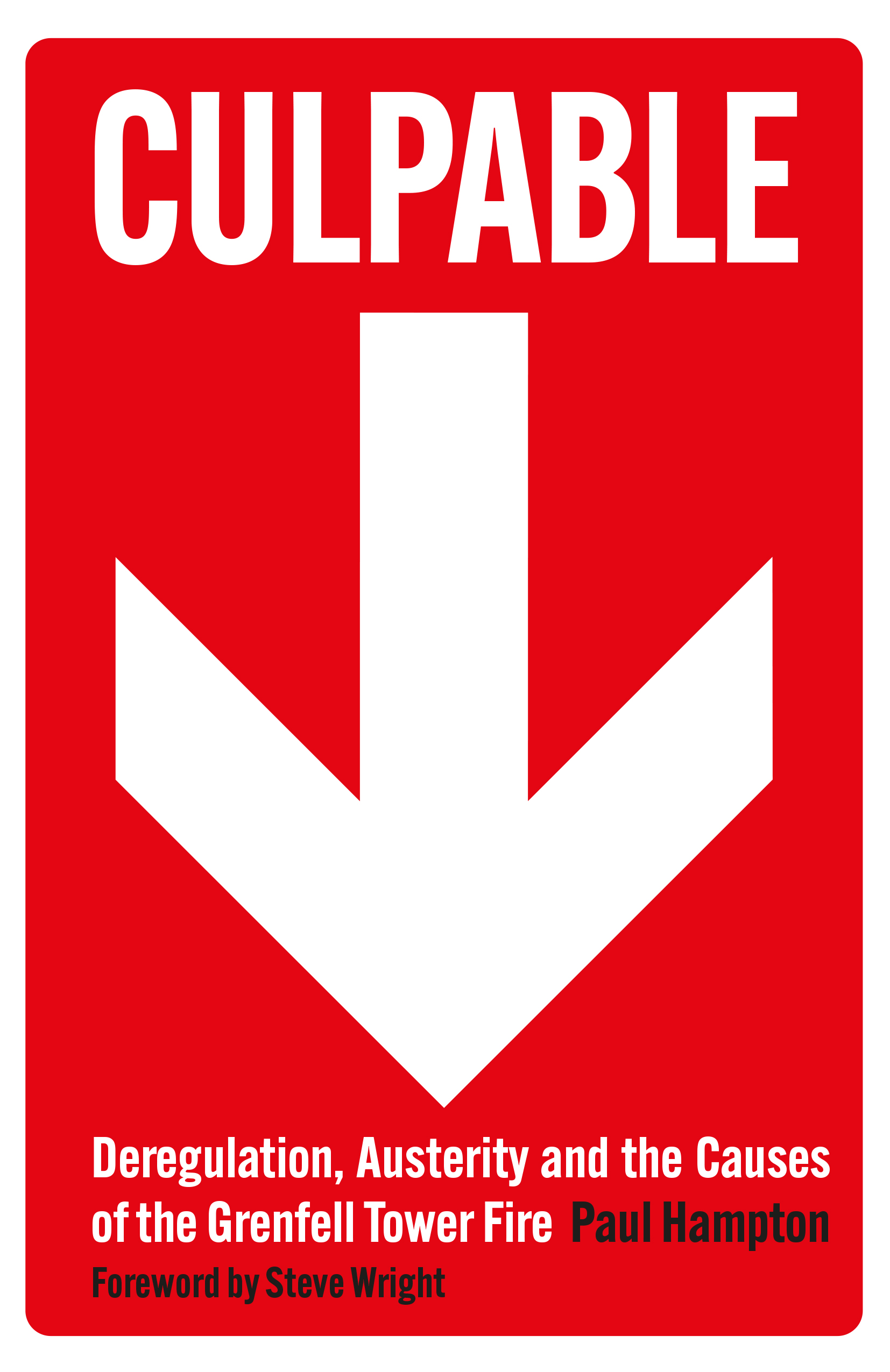
A tower block fire in the nineties should have alerted politicians to the dangers of deregulation – instead they allowed homes to become ticking time bombs. Paul Hampton uncovers a web of complicity and deceit in the new FBU book on the causes of the Grenfell Tower fire
On 5 April 1991, fire destroyed all the cladding on one vertical face at Knowsley Heights. All 130 tenants were evacuated. Although nobody was killed, flames were reported as ‘coming from every landing window between the ground floor and the roof ’.
Fire crews told the Liverpool Echo, ‘it was the most frightening thing any of us had ever seen as firefighters’. The BRE investigation found that a deliberate rubbish fire spread to the ventilated cavity of the cladding system and propagated upwards.
Fire spreads...
Fire penetrated the uPVC window frames at each floor on the façade. The cladding panels on all floors melted, fell away or were taken down later for safety. The Capex rainscreen cladding consisted of mineral fibre insulation with aluminium rails supporting panels of a Class 0 surface spread of flame rating. There were no cavity barriers.
The BRE summary stated:
“Regulations are mainly concerned with the problem of internal fires spreading out of a building and not to the rare event of an external fire penetrating the building, as in this case. It was most fortunate that there was no serious injuries or life loss …”
“A matter of time”
Two months after the fire, Private Eye magazine observed ‘the Building Research Establishment (BRE) is not expected to make a great fuss of its report into the fire at Knowsley Heights, a showpiece council tower block in Merseyside’.
They added that ‘most fire[fighters] who study these things believe that it is only a matter of time before there is a major national fire disaster in Britain’s prematurely ageing tower blocks.’
For the public inquiry, Luke Bisby, a professor of fire and structures, wrote a withering assessment of the BRE investigation:
The fact that the rainscreen cladding at Knowsley Heights was combustible (and possibly also not Class 0 on its inside face), appears never to have been openly stated or discussed in any documentation that I have reviewed in my role as expert witness to the Inquiry …
The BRE investigation into Knowsley Heights failed to fully address the degree to which the presence of a combustible rainscreen may have contributed to the spread and magnitude of the fire. Even with the considerable benefit of hindsight, I struggle to understand how this factor could have been overlooked during these investigations.
Complicity uncovered
By 1991, BRE was already run like a business, while still subject to government deregulation policy. Government complicity can be gleaned from internal communications, which have since been made publicly available in the National Archives.
On the same day as the fire, Alison Curtis of the government’s Housing Management Estates Action (HMEA) division drafted a handwritten note to BRE’s Penny Morgan, who would carry out the on-site inspection into the fire. Curtis claimed that the Knowsley fire was ‘insignificant’, the block had ‘performed well’ and that ‘all materials used in the over cladding and insulation are non-combustible’.
Caught red handed
Another handwritten note found in the archives, undated and signed only by ‘Lyn’ read:
‘We have received via HMEA a request from M St Press Office to play down the issue of the fire. Our briefing for S of S will be purely factual and as far as we are aware Knowsley will not be making an issue of the fire.’
The ‘S of S’ (secretary of state) at the time was Michael Heseltine, the original architect of deregulation of building safety a decade earlier. The ‘M Street Press Office’ refers to government offices at Marsham Street. ‘Knowsley’ here refers to the council, the landlord of the block…
- This is an edited extract from Chapter 5 of Culpable: Deregulation, Austerity, and the Causes of the Grenfell Tower Fire by Paul Hampton with a foreword by FBU general secretary Steve Wright, available for pre-order now through Pluto Press