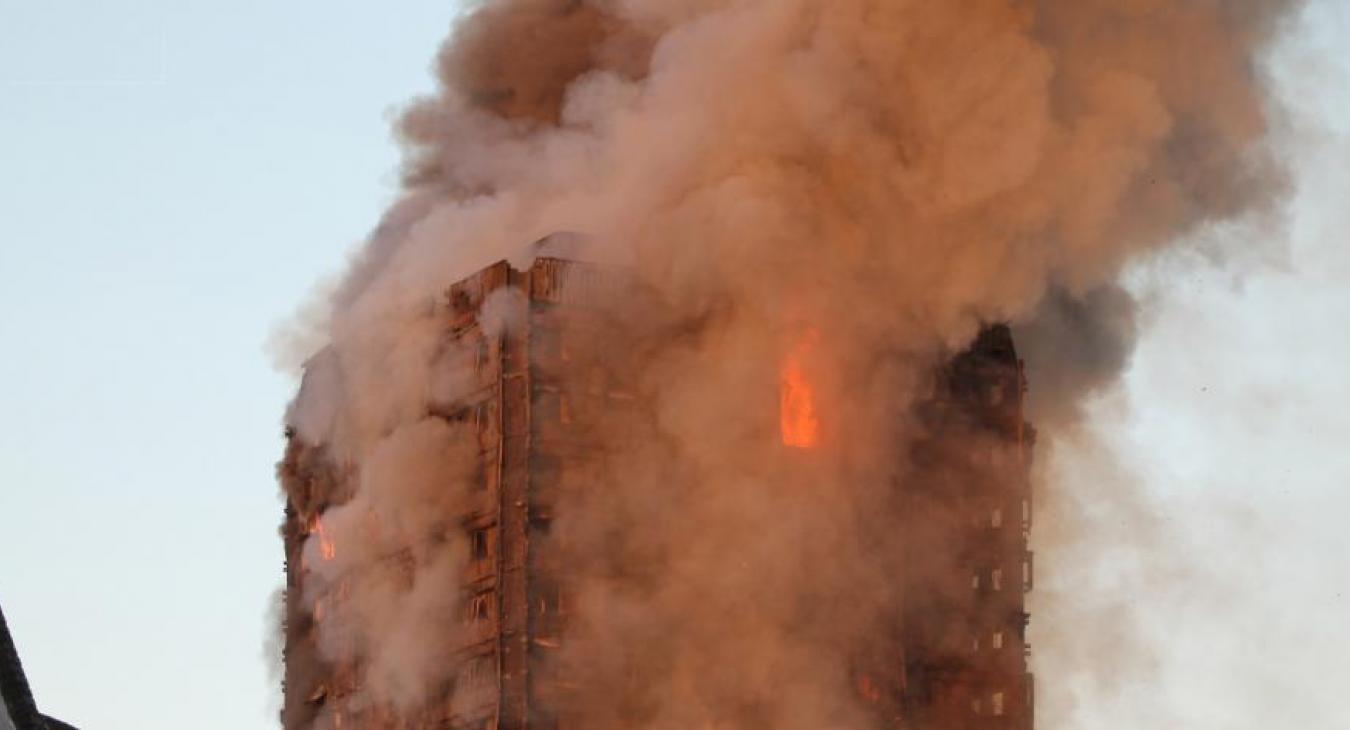
Action to safeguard the public and firefighters from avoidable death and injury tends to follow disasters like Grenfell Tower. Lessons learned this time must end and reverse decades of ‘deregulation’ that was driven by greed and ignorance, says historian Shane Ewen.
The Grenfell Tower disaster raises serious questions about the role of the state in ensuring public safety. There are many historical fire disasters that demonstrate the necessity of learning lessons quickly in order to reassure local communities that similar tragedies will not occur. But deregulation of public services and fire codes by successive governments has weakened the state’s hold over fire safety.
Governments in the UK have historically taken a reactive approach towards fire safety. For the first half of the twentieth century, regulations applied to industrial workplaces alone, and were only strengthened after major fires.
The 1960s saw an extension of safety regulation into other workplaces – licensed premises (1961) and shops, offices and railway premises (1963) – following fatal fires in a Liverpool department store and a Bolton nightclub.
The Fire Precautions Act (1971) was another reactive measure following a hotel fire in Saffron Walden.
It empowered fire authorities to enforce safety through inspection and certification of premises. It legitimated the fire service’s growing expertise in fire prevention but, owing to strict enforcement, was criticised by business leaders and politicians in the 1000s and 1990s.
Beginning with Thatcher’s Conservative government, a 30-year period of deregulation of fire safety followed, justified by successive governments asserting that the abolition of “red tape” was good for both private business and public sector efficiency.
Deregulation continued under New Labour with the privatisation of fire safety research and the introduction of risk assessments. The 2005 Regulatory Reform (Fire Safety) Order ended certification by fire authorities and transferred responsibility for safety onto a combination of employer, employee, occupier and landlord.
The stated aim was to generate a more safety-conscious public, with individuals taking greater responsibility for their own safety, or for the safety of those they were responsible for. This was part of a government-wide shift away from direct enforcement, towards contracting out compliance to non-governmental bodies.
There has been little attempt to revise fire safety codes since 2006 despite fatal fires in multi-storey housing.
In 2009 a fire at Lakanal House in South London killed six people; a year later, a tower block fire in Southampton claimed the lives of two firefighters.
These fires have raised urgent questions about the effectiveness of the deregulated safety regime, especially in tower blocks refurbished with cheap flammable materials and ineffectively inspected.
Lessons were not acted upon quickly enough in the opinion of the all-party parliamentary fire safety and rescue group. The coroner’s report into the Lakanal fire was not published until 2013, and its main recommendations were still under review by government in 2016.
Questions have thus emerged about the state’s duty of care to its citizens and the government’s failure to act promptly to prevent similar incidents. Calls for a public inquiry into the causes of the Grenfell disaster have been heeded by the prime minister, but at the time of writing it is not clear how wide ranging it will be.
This is particularly important given the delayed response from the government and the Royal Borough of Kensington and Chelsea to help survivors in the immediate aftermath of the tragedy. The inquiry must take evidence from everyone involved in the fire, including residents and firefighters.
RISK-TAKING
Firefighters will always risk their lives to save others, regardless of the conditions under which they work. Historic cases of firefighter deaths at major incidents demonstrate the way that risk-taking has been embedded into the service’s working culture.
For example, a huge explosion at a warehouse fire in Glasgow in 1960 killed 19 firefighters. Action was triggered: the service’s professional associations, in particular the FBU, embedded safety in training and reviewed the lessons again in the mid-1990s after yet more firefighter deaths.
The union did so through its membership of the Central Fire Brigades Advisory Council (CFBAC), which was formed in 1947 to provide specialist advice on fire service policy to the home secretary. The CFBAC provided a national forum through which professional knowledge could be shared between partners. It also coordinated national policies in training, operational procedures, and standards of emergency response – until it was abolished in 2004 as part of the wider deregulation of public services.
Since then, the service has lacked a robust machinery for sharing professional experience and clear channels of communication with central government.
The FBU’s repeated warnings of dangers have, until recently, fallen on deaf ears. The government needs to listen to its firefighters if it is going to address clear deficiencies in its fire safety standards, and implement the lessons learned from avoidable disasters such as Grenfell.
History shows that there is a precedent for doing so, and that the Grenfell tragedy must define a new era in fire safety.